Introduction
When an infrared thermometer is aimed at glass, the displayed temperature may differ significantly from the expected value. In many cases, it also cannot determine the true temperature of an object located behind the glass. This often leads to the assumption that infrared thermometers simply cannot measure glass.
That conclusion is not entirely correct.
A conventional industrial infrared thermometer can often measure the surface temperature of the glass itself, provided the measurement conditions are appropriate. However, it generally cannot “see through” ordinary glass to measure the temperature of an object behind it in the same way that visible light passes through a window.
Accuracy may also be influenced by glass composition, thickness, surface treatment, emissivity, reflected ambient radiation, and the spectral response range of the infrared thermometer.
Understanding this distinction requires first understanding what an infrared thermometer actually detects.
Key Points
● An infrared thermometer measures infrared radiation reaching its detector from the target area rather than directly sensing internal material temperature.
● Transparency to visible light does not mean that glass is equally transparent at infrared wavelengths.
● Many industrial infrared thermometers operate in the approximately 8–14 μm long-wave infrared range, where ordinary glass generally cannot be treated as transparent.
● The instrument therefore usually measures radiation associated with the glass surface rather than the temperature of an object behind the glass.
● Surface reflection, emissivity settings, measurement angle, and surrounding thermal sources can affect accuracy.
● Measuring an object through a protective window requires a temperature measurement system and window material specifically matched to the required infrared wavelength range.
What Does an Infrared Thermometer Actually Measure?
Every object above absolute zero emits electromagnetic radiation, part of which lies within the infrared spectrum.
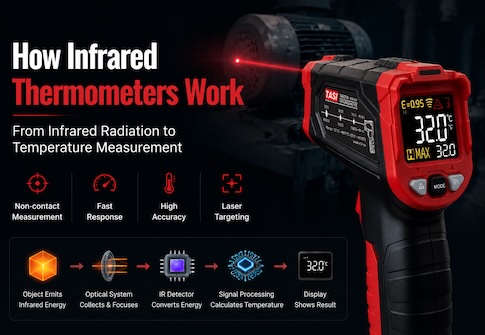
An infrared thermometer uses its optical system to collect infrared radiation from the target area. The detector converts this radiation into an electrical signal, and the instrument calculates surface temperature using factors such as emissivity, ambient compensation, and its internal calibration algorithm.
The radiation received by the instrument may include:
● Infrared radiation emitted by the target itself;
● Ambient infrared radiation reflected from the target surface;
● For infrared-transparent or partially transparent materials, radiation transmitted through the material from objects behind it.
Measurement accuracy therefore depends strongly on the relative contribution of emitted, reflected, and transmitted radiation.
Why Can We See Through Glass but an Infrared Thermometer Cannot?
This is one of the most common misunderstandings in infrared temperature measurement.
Human vision detects visible light primarily between approximately 0.4 and 0.7 μm. Ordinary glass transmits a large proportion of radiation within this wavelength range, which is why objects behind it remain visible.
Infrared thermometers operate at different wavelengths.
Many industrial infrared thermometers use a spectral response of approximately 8–14 μm. At these long-wave infrared wavelengths, ordinary glass behaves very differently from how it behaves in the visible spectrum and should not be considered transparent.
As a result, when an infrared thermometer is aimed at a glass pane, it normally does not receive the full infrared emission from the object behind the glass. Instead, the detector primarily receives radiation emitted by the glass itself together with infrared radiation reflected from its surface.
This is why a conventional infrared thermometer generally cannot be used through an ordinary glass window to measure the temperature of equipment, pipes, machinery, or other objects located behind it.
Can an Infrared Thermometer Measure the Surface Temperature of Glass?
Yes, under appropriate conditions.
If the objective is to measure the temperature of the glass surface itself, an industrial infrared thermometer can often provide useful measurements. The main challenge is that glass is not an ideal blackbody, so the result may be influenced by both emissivity and reflected infrared radiation.
For example, when measuring the surface of a heated glass panel, much of the infrared radiation received by the thermometer may originate from the glass surface itself. A meaningful surface temperature can therefore be obtained when the measurement setup is properly controlled.
However, if the user aims the thermometer through the glass at a motor, heater, or other object behind it, the displayed value will generally not represent the actual temperature of that object.
The distinction is therefore important:
● Measuring the surface temperature of glass is generally possible with suitable settings and measurement conditions;
● Measuring the temperature of an object through ordinary glass is generally not possible with a conventional infrared thermometer.
Why Can Glass Surface Measurements Still Be Inaccurate?
Errors when measuring glass are usually caused by several factors acting together rather than by a single issue.
● Incorrect emissivity setting: Infrared thermometers calculate temperature based partly on the emissivity assigned to the target. If the setting differs substantially from the actual emissivity of the glass surface, the temperature reading can be inaccurate.
● Surface reflection: Glass reflects part of the infrared radiation from its surroundings. Nearby heaters, furnaces, people, lamps, or other warm objects can therefore influence the reading.
● Different surface treatments: Clear glass, coated glass, Low-E glass, mirrored glass, frosted glass, and other treated surfaces may have significantly different infrared properties.
● Excessive measurement angle: Measuring at a steep angle can increase the influence of reflected radiation. Measurements should generally be made as close to perpendicular to the surface as practical.
● Insufficient target size: At long measurement distances, the thermometer’s measurement spot may extend beyond the glass area and include infrared radiation from surrounding surfaces.
● Large temperature differences across the glass: The surface temperature of a glass panel does not necessarily equal the temperature through its full thickness, the temperature on the opposite side, or the temperature of objects behind it.
Why Can’t Equipment Temperature Be Measured Through Glass?
Consider a hot machine located behind a glass inspection window.
Because the machine is clearly visible, it may seem reasonable to aim an infrared thermometer directly at it.
However, at the long-wave infrared wavelengths used by many standard instruments, the machine’s infrared emission does not pass through ordinary glass in the same way as visible light.
The thermometer may therefore receive radiation mainly from:
● Thermal radiation emitted by the glass itself;
● Ambient infrared radiation reflected by the glass;
● A limited transmitted component depending on glass composition, thickness, and wavelength.
The displayed temperature may consequently be close to the glass surface temperature rather than the actual temperature of the equipment behind it.
A machine operating at a high internal temperature can therefore appear significantly cooler when measured through an ordinary glass inspection panel.
Why Does Glass Reflect Infrared Radiation from the Surroundings?
The infrared radiation detected by a thermometer does not always originate entirely from the target itself.
For an opaque material, a simplified relationship can be expressed as:
Emissivity + Reflectivity ≈ 1
When surface emissivity is relatively low, reflected ambient infrared radiation generally becomes more significant.
A reflective glass surface may therefore redirect infrared radiation from nearby thermal sources toward the thermometer.
For example:
● Radiation from the operator may be reflected by the glass if the instrument is used at close range;
● A nearby furnace or heater may be reflected into the measurement area;
● A relatively warm environment can cause the apparent temperature of a colder glass surface to read higher than expected.
Measurement position and surrounding thermal conditions are therefore particularly important when working with reflective surfaces.
How Can Glass Surface Temperature Measurement Be Improved?
If the objective is to measure the temperature of the glass itself, several practices can help reduce measurement error:
● Confirm that the measurement is intended for the glass surface rather than an object behind it.
● Set an emissivity value appropriate for the specific glass type and surface condition rather than assuming that all glass has the same emissivity.
● Measure as close to perpendicular to the glass surface as practical to reduce reflection-related error.
● Avoid positions where the glass reflects people, heaters, furnaces, lamps, or other strong thermal sources toward the thermometer.
● Maintain an appropriate measurement distance so that the entire measurement spot remains within the intended target area.
● For high-accuracy applications, a high-emissivity reference tape, coating, or reference surface may be used for comparison, provided that it has reached thermal equilibrium with the glass.
● For critical process measurements, verify the result with a calibrated reference instrument or a suitable contact temperature sensor.
Do Coated Glass and Ordinary Glass Give the Same Result?
Not necessarily.
Modern architectural and industrial glass may include functional coatings such as Low-E coatings, metallic layers, or other optical treatments.
These coatings can significantly change infrared emissivity and reflectivity.
Low-E glass, for example, is specifically designed to reduce radiative heat transfer over selected wavelength ranges. Measuring it using settings appropriate for untreated glass can therefore produce substantial temperature errors.
For coated glass, emissivity should not be selected solely on the basis that the target material is “glass.” The specific coating, surface orientation, and optical properties must also be considered.
Can Infrared Thermometers Measure Through All Transparent Materials?
No.
“Transparent to the eye” and “transparent to infrared radiation” are entirely different optical properties.
Infrared transmission depends on factors including:
● Material composition;
● Material thickness;
● Infrared wavelength;
● Surface coatings;
● Operating temperature;
● Optical system design.
Some materials that are transparent in visible light are opaque at long-wave infrared wavelengths. Conversely, certain specialized materials that do not resemble ordinary glass can provide high infrared transmission within selected wavelength ranges.
Industrial systems that need to measure through a protective window therefore use infrared window materials specifically selected to match the spectral range of the temperature measurement system.
Which Applications Require Particular Attention to Glass?
Incorrect measurements through glass are especially common in applications such as:
● Measuring machinery through an inspection window;
● Measuring outdoor targets through a building window;
● Measuring products inside refrigerated or heated display cabinets through glass doors;
● Measuring vehicle components through windows;
● Measuring laboratory equipment through protective glass covers;
● Measuring coated, Low-E, mirrored, or reflective glass surfaces.
In these situations, the user should first determine which surface is actually contributing the infrared radiation received by the instrument rather than relying only on where the aiming laser appears.
Why Doesn’t a Laser Spot Behind the Glass Mean the Thermometer Is Measuring That Object?
This is an important operating principle.
On most handheld infrared thermometers, the laser is used primarily as an aiming aid. It is not the infrared radiation used by the detector to determine temperature.
The visible laser may pass through glass and illuminate an object behind it, while the infrared radiation required for temperature measurement may not pass through the same glass at the thermometer’s operating wavelength.
Therefore:
● The position of the laser spot does not always identify the actual infrared source being measured;
● A laser passing through glass does not prove that the thermometer can measure through the glass;
● Whether through-window measurement is possible depends on the spectral response of the thermometer and the infrared transmission characteristics of the window material.
FAQ
Can an infrared thermometer measure glass at all?
Yes. A conventional infrared thermometer can often measure the surface temperature of glass, but accuracy depends on emissivity, reflection, surface treatment, measurement geometry, and surrounding thermal conditions.
Can I measure an object behind glass?
With common industrial infrared thermometers operating around 8–14 μm, an object generally cannot be measured accurately through ordinary glass.
Why can the laser pass through the glass?
The aiming laser operates in the visible spectrum, while temperature measurement uses infrared radiation at a different wavelength. Glass has different transmission characteristics at different wavelengths.
Do I need to set emissivity when measuring glass?
Yes. If the thermometer provides adjustable emissivity, the setting should correspond to the actual glass type and surface condition. Coated, frosted, mirrored, or specially treated glass may require different values.
Why does the temperature change when I change the measurement angle?
Changing the angle changes the reflection geometry of the glass surface. At larger angles, reflected ambient infrared radiation may have a greater influence on the measurement.
Can Low-E glass be measured using the same settings as ordinary glass?
Not necessarily. Low-E coatings can significantly alter infrared emissivity and reflectivity, so the appropriate measurement method should be based on the specific surface and coating.
How can I tell whether I am measuring the glass or the object behind it?
With an ordinary long-wave infrared thermometer and conventional glass, the reading should generally be assumed to represent the glass surface rather than the object behind it. Through-window measurement requires confirmation that the window material has sufficient transmission within the thermometer’s operating wavelength range.
Conclusion
One of the most common misconceptions in infrared temperature measurement is assuming that because ordinary glass is transparent to visible light, it must also be transparent to infrared radiation.
Most conventional industrial infrared thermometers operate in the long-wave infrared range, where ordinary glass does not transmit radiation in the same way it transmits visible light. When the instrument is aimed at glass, the detector therefore generally receives radiation associated with the glass surface and reflected surroundings rather than the true thermal radiation of an object behind the glass.
It is therefore important to distinguish between measuring the surface temperature of glass and measuring an object through glass. The first is generally possible when emissivity, measurement angle, target size, and reflected radiation are properly controlled. The second normally requires a specialized infrared window material and a measurement system matched to its transmission band.
For professional through-window temperature measurement, the spectral response of the instrument, infrared transmission of the window, emissivity, reflection, and optical geometry must all be evaluated together.