Introduction
Infrared thermometers and thermal imaging cameras are both widely used for non-contact temperature measurement. Both detect infrared radiation emitted from an object's surface and convert the detected energy into temperature information. They are commonly used in industrial maintenance, electrical inspection, HVAC, mechanical equipment diagnostics, and building inspection.
However, the two instruments are not functionally identical.
In simple terms, an infrared thermometer is better suited to quickly measuring the temperature of a specific target area, while a thermal imaging camera is designed to visualize temperature distribution across a wider area. One focuses primarily on temperature measurement; the other is particularly useful for locating thermal anomalies.
Understanding this distinction is essential when selecting the appropriate instrument.
Key Points
● Infrared thermometers primarily provide a temperature reading, while thermal imaging cameras provide a visual temperature distribution.
● Infrared thermometers are well suited to targeted measurements, whereas thermal imaging cameras are more effective for area scanning and locating anomalies.
● Both technologies are affected by emissivity, reflections, measurement distance, and environmental conditions.
● A thermal imaging camera is not automatically more accurate than an infrared thermometer; instrument selection should be based on the inspection objective.
● If the measurement location is already known, an infrared thermometer is often the more direct solution. If unknown hot or cold spots need to be located, a thermal imaging camera generally offers greater efficiency.
Basic Differences Between Infrared Thermometers and Thermal Imaging Cameras
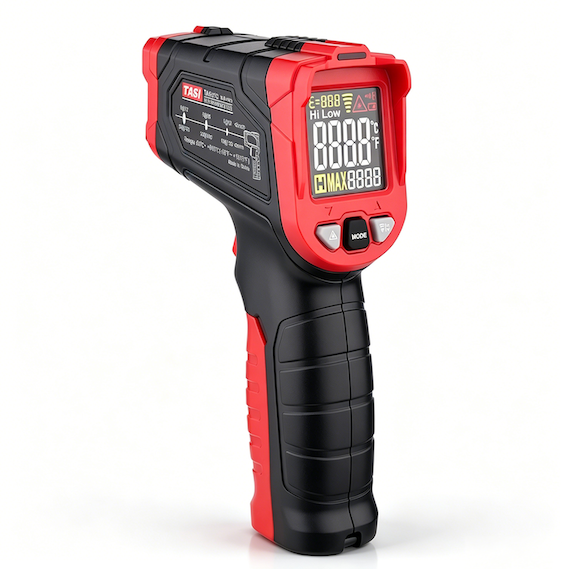
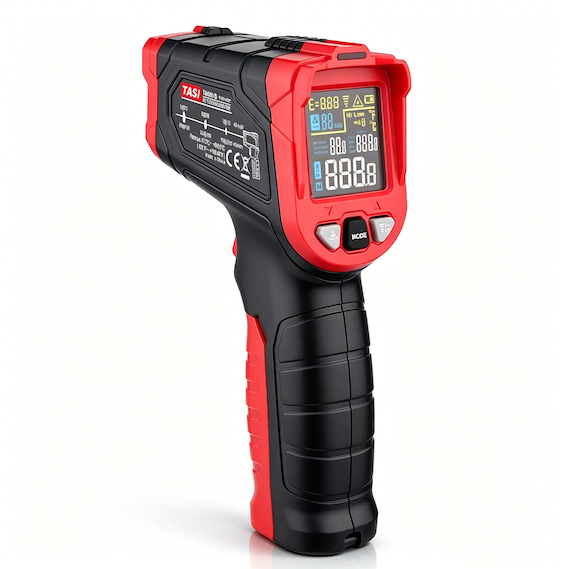
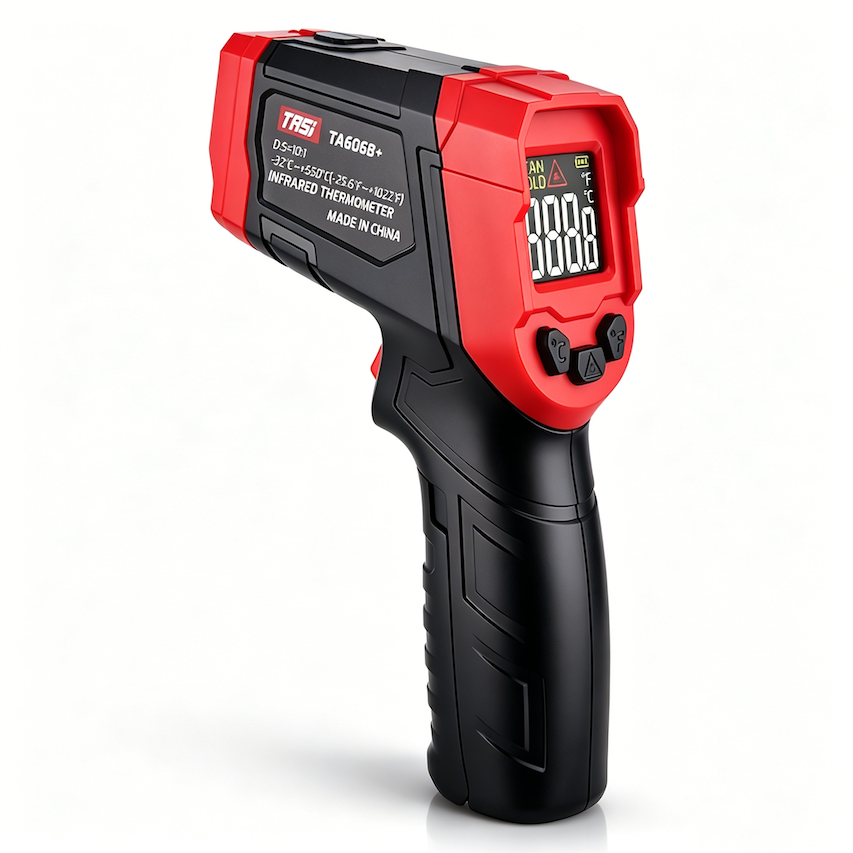
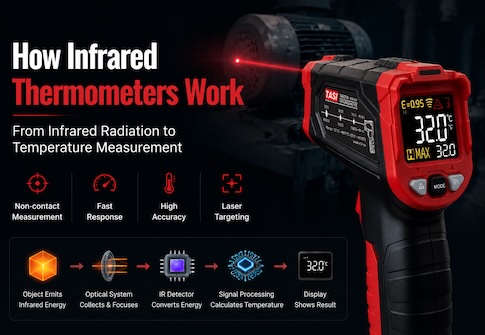
An infrared thermometer uses an optical system to collect infrared radiation from a defined field of view. The detected radiation is converted into a temperature reading. During use, the operator points the instrument at the target area and reads the temperature directly from the display.
A thermal imaging camera also detects infrared radiation, but its infrared detector normally contains a large array of sensing elements. These elements simultaneously capture infrared information from multiple points within the field of view and convert the data into a two-dimensional thermal image.
The fundamental difference is therefore not simply whether an image is displayed, but how temperature information is acquired.
● Infrared thermometer: provides a temperature reading corresponding to its measurement field.
● Thermal imaging camera: collects temperature information from many points within the field of view and displays the resulting temperature distribution.
For example, when inspecting an electrical cabinet, an infrared thermometer is effective if the terminal or connection to be checked is already known. If the source of overheating is unknown, a thermal imaging camera can scan the cabinet and help identify abnormal hot areas more quickly.
How Do the Measurement Results Differ?
The most direct output from an infrared thermometer is usually a numerical temperature value, for example:
● 56.8°C
● 82.3°C
● 105.6°C
Some models can also display maximum, minimum, average, differential temperature, or high/low temperature alarms, but their primary function remains numerical temperature measurement.
A thermal imaging camera produces an image composed of multiple temperature data points. Different temperature regions are represented by different colors or grayscale values, allowing the operator to visualize the thermal distribution of the target surface.
For example, the overall temperature of an operating motor may appear normal, while one bearing area is significantly hotter than surrounding components. With an infrared thermometer, multiple locations would need to be checked individually. A thermal imaging camera can reveal the local hot spot directly in the thermal image.
Therefore:
● An infrared thermometer mainly answers: “What is the temperature here?”
● A thermal imaging camera is particularly effective at answering: “Where is the unusually hot or cold area?”
This is one of the most important practical distinctions between the two instrument types.
How Do Measurement Coverage and Inspection Efficiency Differ?
An infrared thermometer does not measure only the laser spot.
The instrument receives infrared radiation from a circular or approximately circular measurement area. The size of this area depends on the distance-to-spot ratio, or D:S ratio, and the measurement distance. As distance increases, the measured area generally becomes larger.
For example, a 12:1 D:S ratio theoretically means that at a distance of approximately 12 units, the measurement spot is about 1 unit in diameter. In practice, the target should be clearly larger than the measurement spot to reduce the influence of surrounding surfaces.
A thermal imaging camera, by contrast, captures the temperature distribution across an entire field of view at once. It is therefore generally more efficient when inspecting large areas or searching for unknown thermal anomalies.
Typical examples include:
● Large electrical panels
● Terminal blocks and busbar systems
● HVAC piping
● Building surfaces
● Large machinery
● Multiple bearings or electrical connections
A thermal imaging camera can first scan the entire area and then allow the operator to investigate abnormal locations in greater detail.
For individual pipes, bearings, motor housings, heating components, or clearly defined inspection points, an infrared thermometer is often sufficient.
Main Performance and Application Differences
| Comparison | Infrared Thermometer | Thermal Imaging Camera |
|---|---|---|
| Main output | Temperature value | Thermal image and temperature data |
| Inspection method | Point or localized measurement | Area scanning |
| Temperature distribution visualization | Limited | Strong |
| Finding unknown hot spots | Relatively less efficient | Highly efficient |
| Operating complexity | Generally lower | Generally higher |
| Data analysis capability | Relatively simple | Usually more advanced |
| Measurement speed | Very fast for specific points | Efficient for large-area scanning |
| Typical cost | Generally lower | Generally higher |
| Typical use | Routine temperature checks, quick measurements | Fault diagnosis, thermal distribution analysis |
| Result visualization | Direct numerical reading | Highly visual thermal representation |
This table reflects the general characteristics of the two instrument categories. Individual products may vary considerably in temperature range, accuracy, infrared resolution, optics, and software functions. Instrument type alone should therefore not be used to judge specific performance.
Is a Thermal Imaging Camera Always More Accurate?
No.
The ability to generate a thermal image and temperature measurement accuracy are two different characteristics.
One of the main advantages of a thermal imaging camera is its ability to visualize spatial temperature distribution. However, actual temperature accuracy still depends on the instrument specifications, detector performance, calibration, and measurement conditions.
Likewise, a professional infrared thermometer can provide reliable surface temperature measurements when used at an appropriate distance, with the correct emissivity setting and under suitable environmental conditions.
Common factors affecting both instrument types include:
● Target surface emissivity
● Highly reflective surfaces such as polished metals
● Measurement distance
● Target size
● Ambient temperature
● Reflected radiation from nearby hot objects
● Smoke, steam, dust, or other interference in the optical path
● Instrument accuracy and spectral response
A thermal imaging camera should therefore not be considered automatically more accurate simply because it is more advanced or provides an image.
Instrument selection should be based primarily on the inspection task.
When Is an Infrared Thermometer More Suitable?
An infrared thermometer is generally more convenient when the target location is already known and the primary requirement is to obtain a temperature value quickly.
Typical applications include:
● Measuring motor housing temperature
● Checking bearing surface temperature
● Measuring HVAC outlets or piping
● Checking heating equipment surfaces
● Monitoring product surface temperature on production lines
● Inspecting refrigeration equipment
● Routine temperature checks at known electrical connections
Infrared thermometers are typically compact, simple to operate, and provide rapid readings, making them suitable for everyday maintenance work.
They are also efficient for routine inspections involving many predefined measurement points.
When Is a Thermal Imaging Camera More Suitable?
A thermal imaging camera is generally preferable when the location of an abnormality is unknown and a larger area must be inspected for temperature differences.
Typical applications include:
● Locating abnormal hot spots in electrical panels
● Inspecting breakers, terminals, and busbars
● Scanning large machinery
● Identifying building insulation defects
● Inspecting HVAC and refrigeration temperature distribution
● Locating abnormal temperature patterns in pipes
● Thermal inspection of solar modules
● Identifying localized overheating in equipment
The key advantage of thermal imaging is its ability to locate anomalies quickly.
For example, an electrical cabinet may contain dozens of connections. Measuring each point individually with an infrared thermometer can be time-consuming and may overlook areas that were not specifically targeted. A thermal imaging camera can scan the entire cabinet and quickly reveal unusual hot spots for further investigation.
Can Infrared Thermometers and Thermal Imaging Cameras Be Used Together?
Yes. In many industrial inspection applications, the two technologies complement each other effectively.
A common approach is to use a thermal imaging camera for broad-area scanning to locate abnormal temperature regions, followed by an infrared thermometer, contact thermometer, or another instrument for additional verification.
Alternatively, an infrared thermometer can be used for routine monitoring of fixed inspection points. If abnormal temperature trends are detected, a thermal imaging camera can then be used to investigate the wider temperature distribution.
The two instruments are therefore not necessarily substitutes for one another.
● Infrared thermometer: suitable for rapid measurement at known locations.
● Thermal imaging camera: suitable for rapidly locating unknown thermal anomalies.
When establishing an industrial temperature inspection program, one or both instrument types may be selected depending on inspection coverage, equipment quantity, fault risk, and budget.
How to Choose Between an Infrared Thermometer and a Thermal Imaging Camera
The first step is to define the primary inspection requirement.
An infrared thermometer is generally the better choice if you need to:
● Quickly check the temperature of a known location
● Use a compact and simple instrument
● Inspect predefined points during routine maintenance
● Primarily record temperature values
● Keep instrument acquisition costs relatively low
A thermal imaging camera is generally more suitable if you need to:
● Scan a large area quickly
● Locate unknown hot or cold spots
● Analyze overall equipment temperature distribution
● Perform electrical fault diagnostics
● Inspect building heat loss or insulation performance
● Store and analyze thermal images
Specific parameters such as temperature range, accuracy, emissivity adjustment, D:S ratio or infrared resolution, operating temperature, and data logging functions should also be evaluated before selecting a model.
FAQ
Can an infrared thermometer replace a thermal imaging camera?
It can meet many requirements in simple point-temperature applications, but it cannot fully replace a thermal imaging camera. An infrared thermometer mainly provides a temperature reading from a defined measurement area, while a thermal imaging camera reveals the temperature distribution across a larger field and is more effective for locating unknown anomalies.
Can a thermal imaging camera be used like an infrared thermometer?
Many radiometric thermal imaging cameras can display the temperature of a selected point within the thermal image and can therefore perform some point-measurement tasks. However, for straightforward and rapid single-point temperature checks, an infrared thermometer is often more convenient.
Why do infrared thermometers use lasers while thermal imaging cameras usually rely on the display?
The laser on an infrared thermometer is primarily an aiming aid and does not perform the temperature measurement itself. A thermal imaging camera displays its complete field of view on the screen, allowing the operator to see the area being inspected directly.
Do both instruments require emissivity settings?
Emissivity is an important factor whenever reliable infrared surface-temperature measurement is required. Some instruments use a fixed emissivity value, while others allow adjustment according to the target material. Highly reflective, low-emissivity surfaces such as polished metals require particular attention because reflected radiation can significantly affect results.
Does measurement distance affect both instruments?
Yes. Infrared thermometers require consideration of the D:S ratio and measurement spot size. Thermal imaging cameras require consideration of field of view, infrared resolution, and the number of detector pixels covering the target. Excessive distance can reduce the amount of usable temperature information in both cases.
Conclusion
Infrared thermometers and thermal imaging cameras both use infrared radiation for non-contact temperature measurement, but they are designed to solve different inspection problems.
Infrared thermometers are compact, simple, and fast, making them well suited to routine temperature measurement at known locations. Thermal imaging cameras display the temperature distribution across an entire area, making them particularly effective for locating unknown anomalies, comparing temperature differences, and diagnosing equipment faults.
The choice should therefore not be based simply on which instrument is considered “better,” but on the actual inspection objective.
If the main question is “What is the temperature at this location?”, an infrared thermometer is often sufficient. If the key question is “Where in this area is the thermal abnormality?”, a thermal imaging camera offers a clear advantage.