Introduction
Many users notice that infrared thermometers tend to produce stable readings when measuring black surfaces. This can create the impression that “black objects are always the easiest or most accurate to measure.”
There is some truth to this observation, but it is not universally correct. Infrared thermometers do not determine temperature based on visible color. Their readings depend primarily on the surface’s emissivity and the infrared radiation emitted by the target.
Many black, matte, non-metallic materials have relatively high emissivity and are therefore well suited to infrared temperature measurement. However, some black metals, glossy coatings, or specially treated surfaces can behave very differently in the infrared spectrum.
For this reason, measurement suitability should be evaluated according to material, surface condition, and emissivity rather than color alone.
Key Points
● Black objects are often suitable for infrared temperature measurement, but not all black surfaces have the same emissivity.
● Infrared thermometers detect infrared radiation rather than visible color.
● Many black, rough, matte, non-metallic surfaces have high emissivity and generally provide more stable readings.
● Black metals, glossy surfaces, special coatings, or reflective materials can still produce significant measurement errors.
● Correct emissivity settings, appropriate measuring distance, and ensuring that the target fills the measurement spot are important for reliable results.
Why Are Black Objects Often Easier to Measure with an Infrared Thermometer?
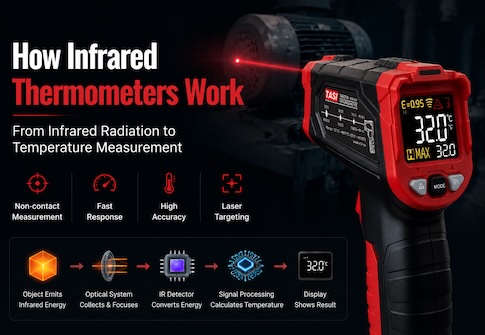
An infrared thermometer measures the infrared energy emitted from a target surface and converts the detected radiation into a surface temperature value.
Under otherwise identical conditions, a surface with higher emissivity emits a larger proportion of its own thermal radiation and is generally less affected by reflected infrared energy from surrounding objects. This allows the instrument to obtain a more representative temperature signal.
Many common black materials, including black plastics, rubber, painted surfaces, fabrics, and certain oxidized materials, have relatively high emissivity. This is why black matte surfaces are often easier to measure reliably than polished metal surfaces.
The important factor, however, is the surface’s infrared radiation characteristics—not simply its visible black color.
Does a Black Surface Always Have High Emissivity?
No.
Visible color is determined by how a material interacts with visible wavelengths, while infrared thermometers operate within infrared wavelengths. These are different regions of the electromagnetic spectrum.
Therefore, a surface that appears black to the human eye does not automatically have high infrared emissivity.
● Matte black paint usually has relatively high emissivity and is generally easy to measure.
● Black rubber and many plastic materials also tend to have high emissivity.
● Black anodized metals may have favorable infrared emission characteristics, but the actual emissivity depends on the specific surface treatment.
● Black but highly polished metals or special coatings may have emissivity values very different from those of conventional matte black surfaces.
● Two objects that both appear black may have significantly different emissivity values because of differences in material and surface finish.
Professional infrared temperature measurement should therefore never determine emissivity from visible color alone.
Why Can a Black Object Still Give an Inaccurate Reading?
Even when the target is black, several factors can cause temperature errors.
● Incorrect emissivity setting: If the thermometer’s emissivity setting differs significantly from the actual surface emissivity, the calculated temperature may be inaccurate.
● Glossy surface finish: Some glossy black surfaces can still reflect substantial infrared energy from nearby heat sources.
● Excessive measuring distance: If the measurement spot becomes larger than the target, radiation from surrounding areas will also affect the reading.
● Oil, moisture, dust, or contamination: Infrared thermometers measure the outermost surface. Deposits or coatings can therefore change the detected temperature.
● Large measurement angle: Measuring at an excessive angle can increase reflection effects and enlarge the effective measurement area.
● Rapid environmental temperature changes: If the instrument is moved from a cold environment to a hot environment, or vice versa, it should be allowed to thermally stabilize before measurement.
● Rapidly changing target temperature: Different readings are normal if the target is actively heating or cooling.
Black surfaces must therefore still be measured under appropriate infrared measurement conditions.
How Does Emissivity Affect the Measurement of Black Objects?
Emissivity describes how effectively a real surface emits infrared radiation compared with an ideal blackbody. Its theoretical value ranges from 0 to 1.
An ideal blackbody has an emissivity of 1, while real materials generally have lower values.
Many common black, non-metallic surfaces have relatively high emissivity. For this reason, many infrared thermometers use a factory default emissivity setting of approximately 0.95. This value is suitable for many painted surfaces, plastics, rubber, wood, paper, and organic materials, but it should not be assumed to apply to every target.
If the infrared thermometer allows adjustable emissivity, the value should be matched as closely as practical to the target material and surface condition when higher measurement accuracy is required.
For materials with unknown emissivity, users can refer to reliable emissivity data or compare the reading with a known temperature reference and adjust the setting accordingly.
Can Black Metal Be Measured Directly?
It depends on the metal surface condition.
Bare, polished, or highly reflective metals are among the more difficult targets for infrared thermometers because their emissivity can be low and their surfaces can reflect infrared radiation from the surrounding environment.
If the metal is coated with a matte black finish, measurement conditions usually improve because the thermometer detects infrared radiation from the outer coating.
However, a metal surface that merely appears dark or black should not automatically be treated as having an emissivity of 0.95.
For higher-accuracy metal temperature measurements, the actual emissivity of the surface should be considered together with possible reflected radiation from nearby heat sources.
How Can Measurement Accuracy on Black Objects Be Improved?
The following practices can improve stability and repeatability when measuring black targets:
● Set the infrared thermometer’s emissivity according to the material and surface condition.
● Select a clean, flat area without strong reflections whenever possible.
● Ensure that the target is larger than the measurement spot at the selected distance.
● Follow the thermometer’s D:S distance-to-spot ratio when selecting measuring distance.
● Measure as close to perpendicular to the target surface as practical and avoid excessive angles.
● Minimize reflections from sunlight, hot equipment, or other nearby heat sources.
● Allow the thermometer to stabilize after significant changes in ambient temperature.
● For higher-accuracy applications, compare readings with a contact temperature sensor or a known reference temperature.
These practices apply not only to black objects but to most infrared temperature measurement applications.
Are Black Objects More Accurate to Measure Than White Objects?
Not necessarily.
For example, both matte black plastic and matte white plastic may have high and relatively similar infrared emissivity. Although they appear very different in visible light, both can provide stable infrared temperature readings.
By contrast, a glossy black metal surface may be more difficult to measure accurately than a matte white non-metallic surface.
In infrared thermometry, material properties and surface emissivity are generally more important than visible color.
FAQ
Are black objects the most accurate targets for infrared thermometers?
Not necessarily. Many matte black, non-metallic materials have high emissivity and are easy to measure, but different black materials can have very different infrared characteristics.
Do I need to adjust emissivity when measuring black plastic?
Many black plastics have relatively high emissivity, and an emissivity setting around 0.95 may provide stable readings. For higher accuracy, however, the appropriate value should be determined for the specific material and surface finish.
Can black metal be measured using an emissivity setting of 0.95?
Not in every case. Metal emissivity depends strongly on oxidation, roughness, coatings, and surface treatment. The actual surface condition should be considered.
Why do I get different readings on the same black object?
Possible causes include changes in measuring distance, measurement location, surface temperature distribution, viewing angle, reflected radiation, instrument stabilization, or actual changes in the target temperature.
Is a black painted surface suitable for infrared temperature measurement?
Most matte black paints have relatively high emissivity and are generally suitable for infrared measurement. Glossy or specially formulated coatings may behave differently and should be evaluated accordingly.
Can painting a surface black improve infrared measurement accuracy?
In some professional applications, a known high-emissivity matte coating can improve measurement conditions on low-emissivity surfaces. The coating must reach the same temperature as the underlying surface and be suitable for the specific application.
Conclusion
Infrared thermometers often provide stable results when measuring black objects, particularly black, rough, matte, non-metallic materials with relatively high emissivity.
However, “black” does not automatically mean “high emissivity,” nor does it guarantee an accurate reading. Reliable infrared temperature measurement depends on the target material, surface finish, emissivity, measuring distance, spot size, viewing angle, and environmental conditions.
For applications requiring higher accuracy, emissivity should be confirmed and the thermometer should be used according to its optical specifications and recommended measurement practices.