Introduction
Infrared thermometers determine surface temperature by detecting infrared radiation emitted by an object. Because the measurement is non-contact, it is sometimes assumed that surrounding air temperature has little or no effect on the result.
In practice, ambient temperature is an important factor in infrared temperature measurement.
Ambient temperature can affect not only the surface temperature of the target, but also the infrared detector, electronic components, optical system, and internal temperature compensation of the instrument. This is particularly important when an infrared thermometer is moved quickly from a cold environment into a warm area, or vice versa.
If measurement begins before the instrument has adapted to the new environment, temporary reading drift or unstable results may occur.
For applications requiring higher measurement accuracy, ambient conditions should therefore be considered together with emissivity, measuring distance, and target size.
Key Takeaways
● Excessively high or low ambient temperatures can affect the stability of infrared temperature measurements.
● Most infrared thermometers use internal ambient-temperature sensing and compensation, but this compensation operates within specified limits.
● After a significant change in environmental temperature, the instrument should be allowed to stabilize before accurate measurements are taken.
● Ambient temperature can also indirectly affect measurement by changing the target surface temperature, reflected background radiation, and atmospheric conditions.
● High-temperature equipment areas, cold rooms, outdoor winter environments, and locations with rapid temperature changes require particular attention.
● Always operate the infrared thermometer within its specified ambient operating temperature range and avoid precision measurements before thermal equilibrium is reached.
Why Does Ambient Temperature Affect Infrared Measurement?
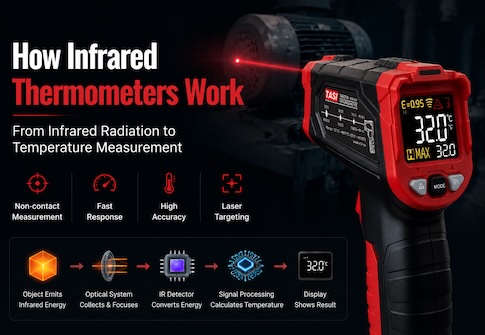
The infrared radiation received by an infrared thermometer is not simply converted directly into a temperature value. The detector first converts incoming infrared energy into an electrical signal, which is then processed together with emissivity settings, internal temperature measurements, and compensation algorithms.
The temperature of the instrument itself can influence detector output.
For this reason, most infrared thermometers incorporate an internal ambient-temperature sensor or equivalent compensation mechanism to correct for changes in detector and instrument temperature.
Under normal conditions, if the instrument is used within its specified operating temperature range and has reached a stable temperature, these effects can usually be controlled effectively.
Problems are more likely to occur when the environmental temperature changes faster than the instrument can reach thermal equilibrium. During this transition period, the compensation system may not fully correct for the temporary thermal imbalance.
For example, an infrared thermometer stored for an extended period in a cold vehicle may still be internally cold when it is brought into a warm indoor environment. Measurements taken immediately may drift until the instrument temperature stabilizes.
What Happens in High Ambient Temperatures?
When an infrared thermometer is used in a hot environment, the detector, electronics, housing, and optical components gradually increase in temperature.
If the ambient temperature remains within the specified operating range and the instrument has stabilized, normal measurement is generally possible. However, high-temperature environments may introduce several additional effects:
● Rising internal temperature can alter detector output and increase the demand on the compensation system.
● When the instrument is used close to furnaces, heaters, steam pipes, or other hot equipment, the housing may be heated directly by thermal radiation.
● Strong background infrared radiation can be reflected from low-emissivity surfaces and cause readings to appear higher than the actual target temperature.
● If the specified operating temperature range is exceeded, measurement accuracy can no longer be assured and instrument performance may be affected.
When measuring furnaces, boilers, heat-treatment equipment, or similar systems, the temperature of the target is therefore not the only consideration. The infrared thermometer itself should not be exposed to excessive heat for extended periods.
What Happens in Low Ambient Temperatures?
Low-temperature environments can also affect infrared measurement.
Typical examples include cold storage facilities, winter outdoor inspections, refrigerated areas, and measurements near cooling equipment.
Possible effects include:
● Detector and electronic characteristics may change at low temperatures, requiring internal compensation to maintain measurement stability.
● Battery performance may decrease in cold conditions, particularly when the battery is already at a low state of charge.
● LCD response may become slower at very low temperatures.
● Moving the instrument rapidly from a cold environment into a warm and humid area may cause condensation on the lens.
Lens condensation is particularly important.
Moisture on the infrared optical surface changes the amount of infrared radiation reaching the detector and can produce significant measurement error. Measurements should not continue until the lens is dry and the instrument has adapted to the new environment.
Why Are Rapid Temperature Changes More Problematic?
A rapidly changing environment can affect infrared measurement more strongly than a stable hot or cold environment.
This is because the different components inside the instrument do not change temperature at exactly the same rate.
For example, when an infrared thermometer is moved from an environment near 5°C into a room at approximately 25°C, the housing may begin warming quickly while the detector, circuit board, and optical components remain colder for some time.
During this transition, a temporary temperature gradient exists inside the instrument. The temperature measured by the internal compensation sensor may not perfectly represent the instantaneous thermal condition of the infrared detector.
This can lead to measurement drift.
As the instrument approaches thermal equilibrium, the reading normally becomes more stable.
After a substantial environmental temperature change, high-accuracy measurements should therefore be delayed until the instrument has stabilized. The required stabilization time depends on instrument design and the magnitude of the temperature change, so the manufacturer’s operating instructions should be followed.
Ambient Temperature Can Also Change the Actual Target Temperature
Environmental temperature does not affect only the infrared thermometer.
The target itself is continuously exchanging heat with its surroundings.
For example, a metal component moved from a cold outdoor environment into a warm building will gradually increase in surface temperature. Repeated infrared measurements will therefore show the temperature rising.
This is not necessarily an instrument error. The target temperature itself is changing.
Similar situations include:
● Products removed from cold storage.
● Components transferred from a hot production line into a room-temperature area.
● Outdoor equipment exposed to direct sunlight.
● Objects located near heat sources, refrigeration outlets, or air-conditioning vents.
● Surfaces affected by condensation, evaporation, or high-velocity airflow.
When evaluating infrared temperature data, it is therefore important to distinguish between an instrument being affected by ambient temperature and a target whose actual temperature is changing because of its environment.
Why Does Background Temperature Matter More for Low-Emissivity Surfaces?
For high-emissivity materials such as many painted surfaces, rubber, plastics, and other non-metallic materials, a large proportion of the detected infrared radiation comes from the target itself.
The situation is more complex with polished metals, aluminium, stainless steel, and other low-emissivity surfaces.
Low-emissivity materials generally reflect more infrared radiation from their surroundings.
If a metal surface is located near a hot furnace, heater, or other high-temperature object, infrared radiation from that source can be reflected by the metal surface toward the infrared thermometer.
The instrument may then indicate a temperature higher than the target’s actual surface temperature.
Conversely, reflection from a colder background can result in a reading that is too low.
For low-emissivity materials, ambient conditions therefore involve another important parameter: reflected background temperature.
This is one reason infrared measurement of metallic surfaces is generally more sensitive to environmental conditions than measurement of high-emissivity materials.
Does Hot Air Directly Affect Infrared Measurements?
Under typical conditions, ordinary air is relatively transparent within portions of the infrared spectrum used by common infrared thermometers. At normal measuring distances, air temperature alone is therefore usually not the primary source of error.
The situation changes when the optical path contains:
● High concentrations of water vapour.
● Smoke or dust.
● Hot exhaust gases.
● Dense fog.
● Steam.
● A long measurement path.
These conditions may absorb, scatter, or emit infrared radiation and therefore change the energy received by the detector.
In boilers, furnaces, steam systems, and dusty industrial environments, a clear and unobstructed optical path between the infrared thermometer and the target should be maintained whenever possible.
How Can Ambient-Temperature Measurement Errors Be Reduced?
Proper operating practices can significantly reduce the influence of environmental temperature.
● Allow the instrument to acclimatize. After a substantial temperature change, allow the infrared thermometer to stabilize before taking important measurements.
● Stay within the specified operating temperature range. Ambient operating limits vary by model and should always be checked in the product specifications.
● Protect the instrument from direct heating. When measuring hot equipment, avoid prolonged exposure of the thermometer housing to furnaces, heaters, or other strong heat sources.
● Check the lens for condensation. After moving from a cold area into a warm and humid environment, verify that the infrared optics are clean and dry.
● Minimize reflected background effects. Particular care is required when measuring low-emissivity metallic surfaces near hot or cold surrounding objects.
● Maintain consistent measurement conditions. For comparative measurements, use similar ambient conditions, distance, angle, and emissivity settings whenever possible.
● Confirm that the target is thermally stable. When a target has recently been moved between environments, determine whether its temperature should be allowed to stabilize before measurement.
Which Applications Require Particular Attention?
In normal indoor environments, ambient-temperature effects may be relatively small. However, additional care is recommended in the following applications:
● Outdoor winter inspections: the instrument may remain at low temperature for extended periods or be moved repeatedly between indoor and outdoor environments.
● Cold storage and refrigeration: low temperature, high humidity, and condensation may all affect measurement.
● Boiler and furnace inspection: strong thermal radiation can directly heat the instrument and increase reflected-radiation effects.
● Industrial production lines: target temperature, ambient temperature, and background temperature may change simultaneously.
● HVAC inspection: strong temperature gradients and high airflow are often present near supply outlets and vents.
● Outdoor equipment inspection: sunlight, wind, and changing ambient temperature can alter the actual surface temperature of equipment.
When measurements are used for trending or comparison over time, recording the environmental conditions can improve the consistency and usefulness of the data.
FAQ
Does a higher ambient temperature always make an infrared thermometer read higher?
● No. Infrared thermometers normally compensate for ambient-temperature changes. A higher surrounding temperature does not automatically produce a higher reading. The main concerns are whether the instrument remains within its operating range and whether it has reached thermal equilibrium.
Can an infrared thermometer be used immediately after bringing it indoors from outside?
● It may be used for general observation, but high-accuracy measurements should ideally wait until the instrument has adapted to the indoor environment. This is especially important in winter when the indoor-outdoor temperature difference is large.
Can ambient temperature affect infrared thermometer accuracy?
● Yes. Measurement error can increase when ambient temperature is very high, very low, changes rapidly, or falls outside the specified operating range.
Why can readings become unstable after leaving a cold room?
● The instrument may still be internally cold, and condensation may also form on the lens. Allow it to acclimatize and make sure the optical surface is clean and dry before resuming measurement.
Why can metal surfaces read too high near hot equipment?
● Low-emissivity metals can reflect infrared radiation from nearby hot equipment. The thermometer may therefore receive radiation that does not originate solely from the target surface.
How long should the instrument be allowed to acclimatize?
● There is no universal stabilization time for all infrared thermometers. It depends on the instrument design and the size of the temperature change. Follow the manufacturer’s operating instructions and specifications.
Conclusion
Ambient temperature does not simply change an infrared thermometer reading by a fixed amount. Instead, it can influence measurement through several mechanisms, including detector temperature, internal compensation, optical condition, actual target temperature, and reflected background radiation.
When the environment is stable and the instrument is operated within its specified temperature range, modern infrared thermometers can normally compensate effectively for ambient-temperature changes.
The conditions most likely to cause significant errors are rapid environmental temperature changes, insufficient acclimatization, operation outside the specified ambient range, lens condensation, and strong reflected thermal radiation.
For reliable infrared measurements, ambient conditions should therefore be considered together with emissivity, D:S distance-to-spot ratio, target size, and measuring distance. Stable measurement conditions and correct instrument use are essential for achieving repeatable and dependable temperature data.