Introduction
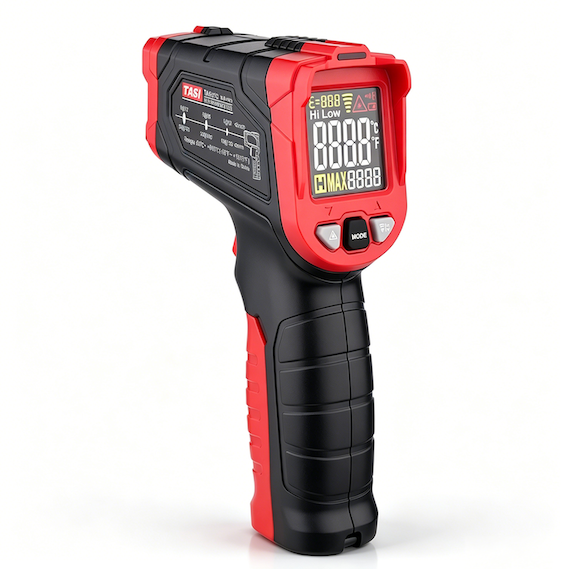
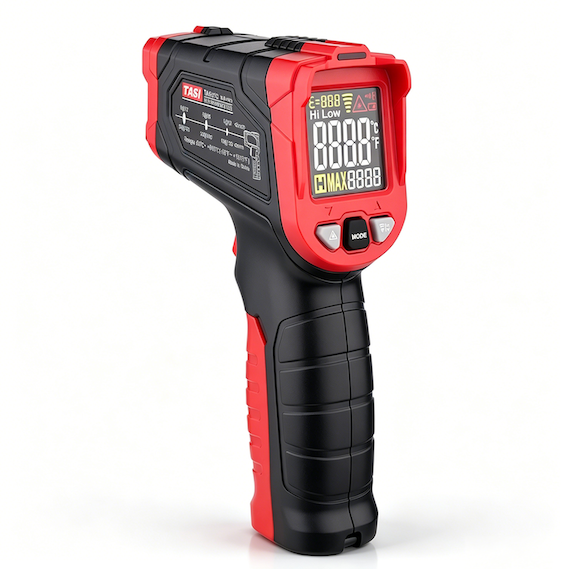
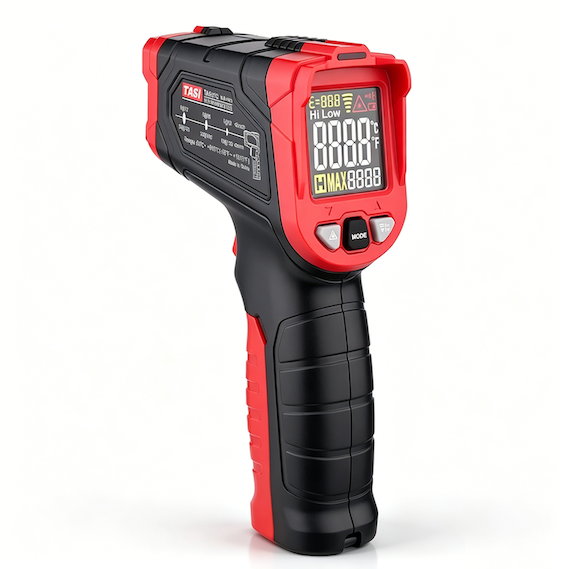
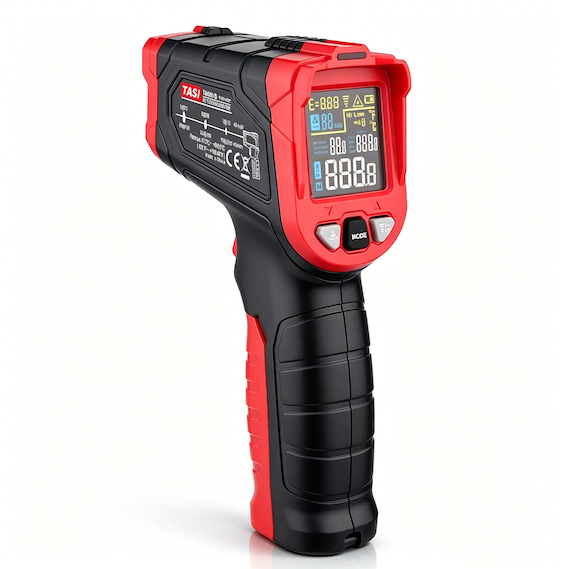
● When using an infrared thermometer, a visible red laser dot is often projected from the front of the instrument. This can create the impression that the laser is measuring temperature. In reality, the infrared thermometer measures the infrared radiation emitted by the target surface. The laser is primarily an aiming and positioning aid.
● Because infrared temperature measurement is non-contact, the instrument is usually operated at some distance from the target. Without a visible reference, it can be difficult to determine exactly which area the instrument is pointing at. Laser aiming helps solve this problem.
● However, the laser dot is not the same as the actual measurement area. Correct interpretation of laser aiming requires an understanding of the optical field of view, measurement spot size, and the D:S ratio of the infrared thermometer.
Key Takeaways
● Infrared thermometers do not measure temperature with the laser. They measure infrared radiation received by the infrared sensing system.
● The laser helps the operator identify where the instrument is aimed.
● The laser dot is generally only an aiming reference and does not represent the full area from which infrared radiation is being collected.
● As measuring distance increases, the measurement spot usually becomes larger, so the laser dot alone is not sufficient to determine whether the target is being measured correctly.
● The instrument's D:S ratio must also be considered when deciding whether a target can be measured reliably.
● Laser aiming is particularly useful for small targets, distant targets, and areas where hot and cold surfaces are located close together.
How Does an Infrared Thermometer Measure Temperature?
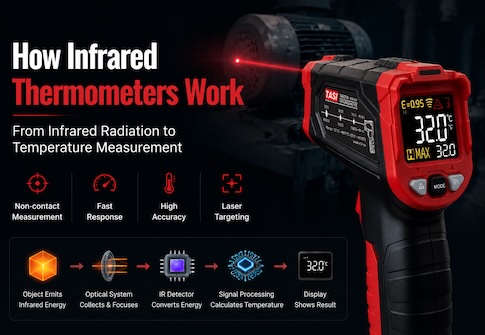
● Any object above absolute zero emits infrared radiation. An infrared thermometer uses an optical system to collect infrared energy from the target surface and focus it onto an internal infrared detector.
● The detector converts the received infrared radiation into an electrical signal. The instrument then calculates surface temperature based on the detected energy, emissivity setting, calibration data, and internal processing.
● The actual temperature reading is therefore determined by the infrared sensing and optical system, not by the visible laser.
● On many infrared thermometers, temperature measurement continues normally even when the laser aiming function is switched off.
● In simple terms: the infrared system measures temperature, while the laser shows where the instrument is aimed.
Why Is Laser Aiming Used on Infrared Thermometers?
To identify the measurement location
● Infrared thermometers are often used at a distance from the target. Without laser assistance, the operator must estimate the measurement direction from the instrument body, which becomes increasingly difficult with small or distant targets.
● A visible laser provides an immediate reference that helps the operator confirm the approximate area being targeted.
To reduce the risk of measuring the wrong area
● In industrial environments, components with very different temperatures may be located close together, such as motor bearings, electrical terminals, heating elements, pipe joints, and mechanical components.
● If the measurement area shifts away from the intended target, the instrument may detect radiation from adjacent equipment, background surfaces, or materials with different temperatures.
● Laser aiming helps the operator position the instrument more consistently on the intended target.
To improve efficiency during distant measurements
● At greater distances, visual alignment becomes more difficult.
● Laser aiming makes it easier to identify the target area during equipment inspection, elevated measurements, or checks on surfaces that are too hot or unsafe to approach closely.
To improve repeatability
● Consistent measurement location is important when monitoring temperature trends over time.
● For example, when checking the same motor bearing every day, changing the measurement position may produce different readings simply because surface temperature is not uniform.
● Laser aiming helps the operator return to approximately the same measurement point, improving the comparability of repeated measurements.
Is the Laser Dot the Actual Infrared Measurement Spot?
● No. The visible laser is normally an aiming reference, while the infrared sensing system measures radiation from an area with a finite diameter.
● The infrared detector does not receive radiation only from the exact location of the laser dot. It collects infrared energy from the area defined by the instrument's optical field of view.
● Therefore, even if the laser dot is positioned in the center of the target, the measured value may still be affected by surrounding surfaces if the measurement spot is larger than the target.
● For example, when measuring a narrow hot pipe, the laser may be centered on the pipe while the actual infrared measurement spot also includes cooler background areas. The displayed temperature may then be lower than the true surface temperature of the pipe.
● This is one of the most common misunderstandings in infrared thermometry: correct laser alignment does not necessarily mean the entire measurement spot is on the target.
How Is Laser Aiming Related to the D:S Ratio?
● The actual measurement spot size is determined by the instrument's D:S ratio, or Distance-to-Spot Ratio.
● For example, an infrared thermometer with a D:S ratio of 12:1 can be approximately interpreted as producing a 100 mm measurement spot at a distance of 1200 mm. This example illustrates the ratio only; actual optical characteristics should always be confirmed in the product specification.
● As measuring distance increases, the measurement spot normally becomes larger. The laser may still remain centered on the target even when part of the measurement spot extends beyond the target surface.
● Laser aiming therefore answers the question, “Where is the instrument pointing?” The D:S ratio answers the question, “How large an area is the instrument measuring?”
● Correct measurement requires both conditions to be considered: use the laser to locate the target, then use the D:S ratio and target size to determine whether the measuring distance is appropriate.
Why Is Laser Aiming More Important for Small Targets?
● With large surfaces such as walls, machine housings, or large pipes, a small aiming error may still leave the entire measurement spot within the target.
● With small targets such as terminals, narrow pipes, bearings, electronic components, or local hot spots, even a slight aiming error may cause the measurement area to include surrounding surfaces.
● Measuring a small target from a long distance is particularly challenging because both operator aiming error and increasing spot size must be considered.
● In practice, the infrared measurement spot should remain fully within the intended target area and preferably be smaller than the usable target surface.
What Is the Difference Between Single-Laser and Dual-Laser Aiming?
● Single-laser infrared thermometers generally use one laser point to indicate the aiming direction. This is sufficient for many routine maintenance and inspection applications.
● Some infrared thermometers use dual lasers or other laser configurations to provide a more intuitive indication of measurement position or approximate measurement area.
● However, laser configurations vary by product. On some instruments, two laser points may indicate boundaries of a measurement area; on others, they may serve only as positioning references.
● The relationship between the laser indicators and the actual optical field of view should therefore always be verified using the manufacturer's documentation, optical diagram, and D:S specification.
Can an Infrared Thermometer Be Used Without the Laser?
● Yes. From a measurement principle perspective, the laser is generally not required for infrared temperature detection.
● For large, close, and clearly defined targets, the operator can often obtain reliable measurements without activating the laser.
● For small, distant, or complex targets, however, laser aiming significantly improves positioning convenience.
● The main benefit of the laser is therefore measurement positioning and operational consistency, not an improvement in the basic accuracy of the infrared detector.
Does Laser Aiming Improve Measurement Accuracy?
● The laser does not directly improve the specified accuracy of an infrared thermometer. For example, switching on the laser does not change the detector's calibrated accuracy specification.
● In practical use, however, laser aiming can reduce errors caused by targeting the wrong area, which can improve the reliability of actual measurement results.
● Instrument accuracy is primarily influenced by factors such as detector performance, optical design, calibration, emissivity, environmental conditions, and signal processing. Laser aiming mainly reduces operator positioning error.
● A more accurate statement is therefore: the laser does not increase the instrument's intrinsic accuracy, but it helps the operator measure the correct target more consistently.
What Should Be Considered When Using Laser Aiming?
● After using the laser to locate the target, verify that the measuring distance is suitable for the instrument's D:S ratio. A laser dot positioned on the target does not by itself confirm that the measurement conditions are correct.
● When measuring small targets, reduce the distance where possible so that the actual infrared measurement spot remains clearly smaller than the target area.
● Avoid allowing the measurement spot to cover multiple areas with significantly different temperatures, as the displayed value may represent the combined infrared radiation received from those surfaces.
● Never direct the laser into a person's eyes or view it through optical instruments. Always follow the laser safety instructions provided with the instrument.
● When measuring reflective metals, glass, transparent materials, or other difficult surfaces, correct laser positioning does not eliminate errors caused by emissivity, reflected infrared energy, or material transmission characteristics.
Which Applications Benefit Most from Laser Aiming?
● Electrical inspection: Laser aiming helps identify specific terminals, circuit breakers, cable connections, and other localised hot spots.
● Mechanical maintenance: It assists in checking motors, bearings, transmission components, and other specific machine areas.
● HVAC inspection: It can help locate particular areas on ducts, vents, compressors, and refrigeration equipment.
● High-temperature equipment: When a surface is too hot to approach safely, laser aiming supports non-contact measurements from a suitable distance.
● Small-target measurement: Accurate positioning is especially important for electronic components, connectors, narrow pipes, and local hot spots, together with proper consideration of the D:S ratio.
FAQ
Does the laser itself measure temperature?
● No. The laser is mainly used for aiming and positioning. Temperature is measured by the infrared sensing system.
Does the laser dot show exactly where the temperature is measured?
● Not completely. The laser indicates the aiming position, while the actual infrared measurement area normally has a finite size that varies with distance.
Why can the reading still be inaccurate when the laser is correctly aimed?
● Possible causes include a measurement spot larger than the target, incorrect emissivity, reflected infrared radiation, environmental effects, excessive measuring distance, or unsuitable target surface characteristics.
Does the measurement area increase as distance increases?
● In most infrared thermometers, yes. The measurement spot becomes larger as distance increases, according to the instrument's D:S ratio.
Can the thermometer still measure temperature when the laser is switched off?
● On most infrared thermometers, yes. The laser and infrared measurement systems are generally independent.
Is a dual-laser infrared thermometer more accurate than a single-laser model?
● Not necessarily. Dual lasers may improve visual positioning, but they do not directly determine temperature measurement accuracy. Overall performance still depends on the detector, optics, D:S ratio, calibration, and operating conditions.
Summary
● Infrared thermometers use laser aiming because non-contact temperature measurement requires a practical visual reference to help the operator identify the intended target.
● The laser does not measure temperature and does not represent the complete infrared measurement area. The actual spot size is determined by the optical field of view and the instrument's D:S ratio.
● Correct use therefore involves more than simply placing the laser dot on the target. The operator must also ensure that the infrared measurement spot remains within the target and consider emissivity, measuring distance, environmental conditions, and surface characteristics.
● In simple terms: the laser indicates where to aim, the infrared system measures temperature, and the D:S ratio determines how large an area is measured.