Introduction
When selecting an infrared thermometer, specifications such as “Resolution: 0.1°C” or “Display Resolution: 0.1°C / 0.1°F” are commonly listed. Resolution is often confused with measurement accuracy, leading some users to assume that a thermometer with higher resolution must also measure more accurately.
In practice, resolution describes how small a temperature change the instrument can display or distinguish. Measurement accuracy depends on several other factors, including sensor performance, calibration, emissivity settings, measurement distance, target size, and ambient conditions.
Understanding resolution correctly is therefore essential when comparing infrared thermometer specifications.
Key Points
● Infrared thermometer resolution indicates the smallest temperature increment the instrument can display or distinguish.
● A resolution of 0.1°C generally means that readings can change in increments of 0.1°C.
● Higher resolution does not necessarily mean higher measurement accuracy.
● Resolution is different from the D:S ratio, which describes the relationship between measurement distance and spot size.
● For most HVAC, electrical, industrial maintenance, and general-purpose applications, 0.1°C display resolution is usually sufficient.
● Infrared thermometer performance should be evaluated using resolution, accuracy, repeatability, emissivity, D:S ratio, and other relevant specifications together.
What Does Infrared Thermometer Resolution Mean?
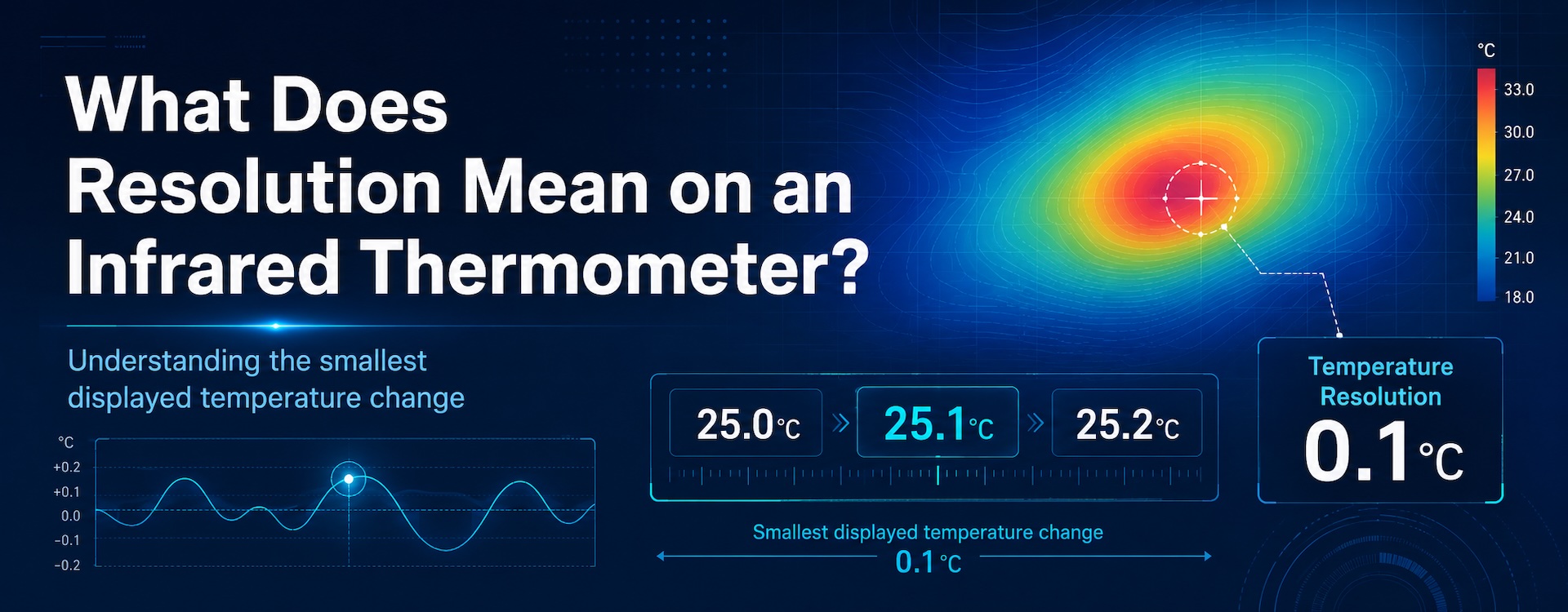
Infrared thermometer resolution generally refers to the smallest temperature increment that can be represented in the displayed measurement result.
For example, if an infrared thermometer has a temperature resolution of:
● 0.1°C
Its readings may be displayed as:
● 25.0°C
● 25.1°C
● 25.2°C
● 25.3°C
This means that the display can represent temperature changes in increments of 0.1°C.
If another instrument has a resolution of 1°C, its display may show:
● 25°C
● 26°C
● 27°C
From a display perspective, 0.1°C resolution provides a finer indication of temperature changes.
It is important to note that the term “resolution” in many product specifications specifically refers to display resolution. It indicates how finely the measurement is displayed, but it does not by itself prove that the actual temperature is being measured with the same level of accuracy.
What Does 0.1°C Resolution Mean?
If an infrared thermometer is specified with a resolution of 0.1°C, the most direct interpretation is that its displayed temperature can change in steps of 0.1°C.
For example, during repeated measurements of the same object, the displayed reading may change from:
35.2°C
to:
35.3°C
The 0.1°C difference represents one display increment.
For applications where small temperature changes need to be observed, such as electronic component temperature rise, HVAC outlet temperature changes, or temperature comparisons between different areas of mechanical equipment, finer resolution can make temperature trends easier to identify.
However, if the thermometer has a specified accuracy of ±1.5°C, a displayed reading of 35.2°C should not be interpreted as meaning that the actual target temperature is known to within 0.1°C.
This is why the number of decimal places alone should never be used to evaluate measurement accuracy.
What Is the Difference Between Resolution and Accuracy?
Resolution and accuracy are two of the most frequently confused infrared thermometer specifications.
Resolution describes the smallest temperature increment the instrument can display or distinguish.
Accuracy describes how close the measured result is expected to be to the actual target temperature.
For example, an infrared thermometer may be specified as:
● Resolution: 0.1°C
● Accuracy: ±1.5°C or a specified percentage of the reading
If the thermometer displays:
100.0°C
The 0.1°C resolution means the display can show one decimal place, while the ±1.5°C accuracy specification indicates the permitted measurement deviation under specified conditions.
Therefore:
● Higher resolution means finer displayed readings.
● Higher accuracy means the measured value is closer to the actual temperature.
● Resolution and accuracy are not interchangeable.
A thermometer that displays 0.1°C increments should not automatically be considered more accurate than another instrument.
What Is the Difference Between Resolution and Repeatability?
Repeatability describes how closely repeated measurements agree when the same target is measured under the same conditions.
For example, with the same distance, emissivity setting, target, and ambient conditions, repeated measurements may show:
50.1°C, 50.1°C, 50.2°C, 50.1°C
This indicates relatively consistent measurement behavior.
Resolution, by contrast, only describes how finely the instrument can display temperature values.
An infrared thermometer may have a resolution of 0.1°C but still show noticeable reading fluctuations if measurement conditions vary or if measurement stability is poor.
Resolution and repeatability should therefore be considered as separate performance characteristics.
What Is the Difference Between Resolution and D:S Ratio?
Resolution and D:S ratio describe completely different characteristics.
Temperature resolution is normally expressed in °C or °F, for example:
● 0.1°C
● 0.1°F
The D:S ratio is normally expressed as a ratio, such as:
● 10:1
● 12:1
● 30:1
● 50:1
D:S describes the relationship between measurement distance and the diameter of the measurement spot.
For example, a 12:1 D:S ratio means that, under idealized conditions, a measurement distance of approximately 1200 mm corresponds to a spot diameter of approximately 100 mm.
Therefore:
● Resolution determines how finely the temperature reading is displayed.
● D:S determines the approximate target area measured from a given distance.
These specifications describe different aspects of infrared thermometer performance and should not be confused.
Does Higher Resolution Mean a Better Infrared Thermometer?
Not necessarily.
Higher temperature resolution can display smaller temperature changes, but overall measurement performance is not determined by resolution alone.
Actual measurement capability also depends on factors such as:
● Whether the measurement accuracy meets the application requirements;
● Repeatability and measurement stability;
● Suitable temperature measurement range;
● Appropriate D:S ratio for the intended measurement distance;
● Correct emissivity setting;
● Proper instrument calibration;
● Whether the target fully covers the measurement spot;
● Ambient temperature, dust, steam, or nearby heat sources.
Two infrared thermometers may both have 0.1°C resolution, yet the instrument with better optical performance, calibration, sensor stability, and signal processing may provide more reliable measurements.
Resolution should therefore be evaluated as one specification within the overall instrument performance.
Why Does a 0.1°C Display Not Mean 0.1°C Accuracy?
This distinction is fundamental when interpreting specifications for digital measuring instruments.
A display capable of showing one decimal place only means that the measurement result can be presented in increments of 0.1°C.
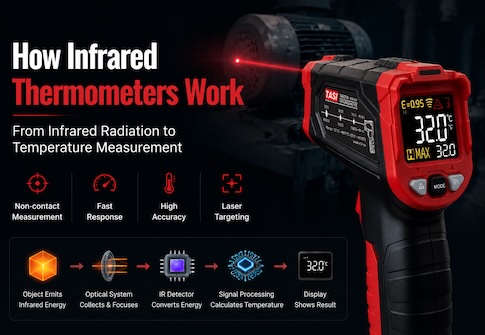
The actual measurement process also involves:
● Infrared radiation detection;
● Optical focusing;
● Infrared sensor conversion;
● Signal amplification and processing;
● Emissivity compensation;
● Ambient temperature compensation;
● Internal calculation algorithms;
● Instrument calibration uncertainty.
Each stage can influence the final measurement result.
Therefore, a displayed value of 35.7°C does not mean that the true target temperature is necessarily known to an accuracy of 0.1°C.
The specified measurement accuracy should always be checked separately.
Which Applications Benefit from Finer Temperature Resolution?
Different applications require different levels of sensitivity to temperature changes.
● Electronics inspection: Finer resolution helps compare temperature rise across PCB components, power modules, connectors, and related parts.
● HVAC measurement: When checking air outlets, ducts, pipes, or equipment surfaces, 0.1°C resolution can make temperature changes easier to observe.
● Mechanical maintenance: Comparing temperatures at bearings, motors, and transmission components can help identify developing temperature trends.
● Laboratory and educational applications: Finer display resolution provides more detailed observation of temperature changes.
● General industrial inspection: In many routine inspections, identifying significant abnormal temperature rise is more important than very fine resolution, making measurement range, accuracy, and D:S ratio equally or more important.
The required resolution should therefore be selected according to the actual measurement objective.
How Should Resolution Be Considered When Selecting an Infrared Thermometer?
A display resolution of 0.1°C is common among handheld infrared thermometers.
When selecting an instrument, it is generally better not to compare products solely by the number of displayed decimal places. Instead, consider:
● First, confirm the required temperature measurement range;
● Check whether the specified accuracy meets the application requirements;
● Select an appropriate D:S ratio based on measurement distance and target size;
● Confirm that the emissivity setting is suitable for the target material;
● Then consider whether finer display resolution is required for observing small temperature differences.
For routine equipment inspection, there is usually little benefit in choosing higher display resolution if measurement accuracy or optical performance is inadequate.
Stable, reliable measurements under the intended operating conditions are generally more important than the resolution figure alone.
Factors That Affect Reading Stability
Even when an infrared thermometer has fine resolution, the displayed reading may fluctuate if measurement conditions are not controlled.
Common causes include:
● The target does not fully cover the measurement spot;
● Measurement distance is too great;
● The target surface has low emissivity;
● Highly reflective metal surfaces are being measured;
● Steam, smoke, or dust is present between the instrument and target;
● The thermometer has recently been moved between environments with large temperature differences;
● The target temperature itself is changing rapidly;
● Hand movement causes the measurement area to shift.
A change of 0.1°C, 0.2°C, or more should therefore not immediately be interpreted as a problem with instrument resolution. Measurement conditions should first be checked for consistency.
FAQ
What does 0.1°C resolution mean on an infrared thermometer?
It generally means that the displayed temperature can change in increments of 0.1°C, such as 25.1°C, 25.2°C, and 25.3°C.
Does 0.1°C resolution mean ±0.1°C accuracy?
No. Resolution and accuracy are different specifications. A resolution of 0.1°C normally refers to the smallest displayed increment, while measurement accuracy is specified separately.
Is 0.1°C resolution better than 1°C resolution?
It provides finer displayed readings and is useful when observing small temperature changes. However, overall instrument performance still depends on accuracy, repeatability, D:S ratio, and other specifications.
Does resolution affect measurement distance?
Not directly. Measurement distance is primarily related to D:S ratio and target size.
Does displaying more decimal places mean the thermometer is more professional?
Not necessarily. Display resolution is only one specification. Accuracy, stability, optical performance, calibration, and measurement conditions are more important when evaluating actual measurement performance.
What resolution is suitable for general industrial measurements?
For most handheld infrared thermometer applications, 0.1°C display resolution is generally sufficient for equipment inspection, HVAC, electrical maintenance, and general industrial measurements.
Summary
Infrared thermometer resolution describes the smallest temperature increment the instrument can display or distinguish. A resolution of 0.1°C generally means that temperature readings can be displayed in increments of 0.1°C.
However, resolution is not the same as measurement accuracy. A thermometer that displays 0.1°C increments does not necessarily measure temperature with an uncertainty of only ±0.1°C.
When selecting or using an infrared thermometer, measurement accuracy, repeatability, temperature range, emissivity, D:S ratio, and operating conditions should all be considered together. For most applications, reliable measurement stability and correct measurement technique are more important than the resolution figure alone.