Introduction
Infrared thermometers determine temperature by detecting infrared radiation emitted from an object's surface. In principle, they can therefore measure the surface temperature of most materials that emit thermal radiation.
However, being able to obtain a reading does not necessarily mean that the reading will be accurate.
Different materials have different emissivity, reflectivity, surface finishes, colours and oxidation conditions. These characteristics can significantly influence infrared temperature measurements. Shiny metals, mirror-like surfaces and certain transparent materials require particular attention because they can produce substantial measurement errors if used incorrectly.
For reliable measurements, it is therefore important to consider not only the instrument's temperature range but also the properties of the target surface.
Key Takeaways
● Infrared thermometers primarily measure surface temperature, not internal temperature.
● Plastics, rubber, wood, paper, painted surfaces and many other high-emissivity materials are generally easy to measure.
● Shiny and polished metals have low emissivity and are more susceptible to reflected infrared radiation from the surroundings.
● Glass can usually be measured, but a standard infrared thermometer normally measures the glass surface rather than an object behind it.
● Water, oil and other liquids can be measured, but the reading primarily represents the temperature of the liquid surface within the instrument's field of view.
● When measuring materials with significantly different emissivities, an infrared thermometer with adjustable emissivity is preferable.
● Measurement accuracy also depends on distance, distance-to-spot ratio, ambient conditions and surface condition.
Why Can Infrared Thermometers Measure Different Materials?
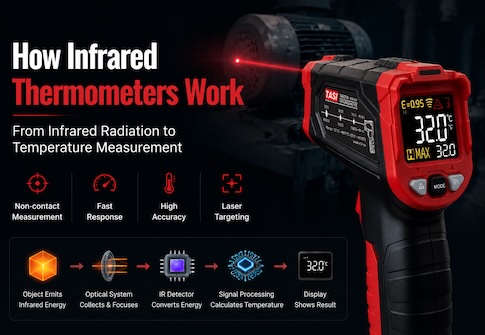
All objects above absolute zero emit electromagnetic radiation, including infrared radiation. As temperature increases, the amount and spectral distribution of emitted infrared energy change.
An infrared thermometer detects this energy using an infrared sensor and converts it into a temperature value based on the instrument's optical characteristics and emissivity setting.
The instrument therefore does not directly measure temperature inside a material. It evaluates the infrared radiation emitted from the surface.
Different materials emit infrared radiation with different efficiencies. This property is described by emissivity. Surfaces with emissivity close to 1 are generally easier to measure accurately. Low-emissivity surfaces reflect a larger proportion of surrounding infrared radiation, which can interfere with the measurement.
Can Plastics Be Measured?
Most common plastics can be measured effectively with an infrared thermometer.
● Materials such as ABS, PVC, PE, PP and nylon often have relatively high surface emissivity.
● Matt, rough or dark plastic surfaces generally provide more stable readings than glossy surfaces.
● Transparent plastics, thin films and surfaces with special coatings require additional attention because transmission and reflection may affect the result.
Infrared thermometers are commonly used for rapid surface-temperature checks in injection moulding, extrusion, plastic welding, thermoforming and electronic enclosure production.
Can Rubber Be Measured?
Rubber is generally well suited to infrared temperature measurement.
Natural rubber, synthetic rubber, tyres, conveyor belts and sealing components typically have relatively high emissivity, allowing stable surface-temperature measurements.
In industrial maintenance, an infrared thermometer can be used to identify abnormal heating on rubber belts, tyres and other mechanical components.
If the surface is covered with oil, water or contamination, however, the measured temperature may represent the covering layer rather than the rubber underneath.
Can Wood, Paper and Textiles Be Measured?
Wood, paper, cardboard, fabrics and most textile materials generally have relatively high emissivity and are therefore suitable for infrared temperature measurement.
● Wood processing: checking surface temperatures after drying, pressing or machining.
● Paper and board manufacturing: rapid temperature checks during production.
● Textile production: monitoring fabrics and materials after heating or thermal treatment.
When the surface is wet, the measured value may predominantly represent the temperature of the moisture layer.
Can Metals Be Measured?
Yes, but metals are among the most demanding materials for infrared temperature measurement.
Metal emissivity varies widely depending on oxidation, roughness, coating and surface finish. Oxidised, rough or painted metals are generally easier to measure, while polished aluminium, stainless steel and copper can have very low emissivity.
● Oxidised metals: generally easier to measure than polished metal.
● Painted or coated metals: usually easier to measure when the coating is uniform.
● Rough metal surfaces: often have higher effective emissivity than polished surfaces.
● Polished metals: can reflect infrared radiation from heaters, machinery, people and other surrounding objects.
For low-emissivity metals, an infrared thermometer with adjustable emissivity is recommended. Where appropriate, a high-emissivity reference tape or suitable surface treatment can also improve measurement reliability.
Can Glass Be Measured?
Yes, but the measurement must be interpreted correctly.
A standard handheld infrared thermometer normally measures the surface temperature of the glass itself, rather than the temperature of an object behind the glass.
Although ordinary glass appears transparent in visible light, it is not necessarily transparent within the infrared wavelength range used by the thermometer.
For example, when the instrument is aimed at a window, the displayed value generally corresponds mainly to the glass surface rather than an object outside the window.
Reflections from the glass surface can also influence the reading, so a stable measurement angle and controlled surroundings are preferable.
Can Water, Oil and Other Liquids Be Measured?
Most liquids can be measured with an infrared thermometer, but the reading represents the surface temperature.
Typical examples include:
● Water in tanks or containers;
● Lubricating and hydraulic oils;
● Cooking oils;
● Paints and certain process liquids;
● Liquid ingredients in food production.
In a stationary liquid, the surface temperature may differ from the temperature deeper inside the container. This difference can become more significant during heating, cooling or when temperature distribution is uneven.
Foam, steam, oil films or other surface layers can also affect infrared measurements.
Where internal liquid temperature is critical, a thermocouple, RTD or another contact temperature sensor should be used for verification.
Can Food Be Measured?
Infrared thermometers are suitable for rapid surface-temperature checks of food products.
Typical applications include:
● Chilled food;
● Frozen food;
● Baked products;
● Cooking and heating surfaces;
● Food-processing production lines.
However, an infrared thermometer cannot directly determine the core temperature of food.
For example, when measuring cooked meat, the infrared thermometer indicates the surface temperature. If the internal temperature is important for process control or food safety, a suitable penetration probe thermometer should also be used.
Can Ceramics, Stone and Concrete Be Measured?
Ceramics, bricks, concrete, stone and similar construction materials generally have relatively high emissivity and can usually be measured reliably with an infrared thermometer.
Typical applications include:
● Checking wall surface temperatures;
● Measuring floor or concrete surface temperatures;
● Monitoring ceramic or refractory materials;
● Inspecting temperature rise around heating equipment.
An infrared thermometer provides a spot or area-averaged surface reading. If a complete temperature distribution across a large area is required, a thermal imager is generally more suitable.
Can Painted and Coated Surfaces Be Measured?
Most painted surfaces are suitable for infrared temperature measurement.
In fact, applying paint to a low-emissivity metal surface often makes infrared measurement easier because the thermometer primarily detects radiation emitted by the coating.
The reading, however, represents the surface temperature of the coating. If the coating is thick or a significant thermal gradient exists between the coating and substrate, the surface temperature may not be identical to the temperature of the underlying metal.
Which Materials Require Special Attention?
The issue is not simply whether a material can or cannot be measured. Some surfaces require more careful measurement conditions.
● Mirror-like metals: highly reflective and strongly influenced by surrounding infrared radiation.
● Polished aluminium, copper and stainless steel: often have low emissivity and require appropriate emissivity settings.
● Transparent materials: visible transparency does not indicate infrared transparency.
● Very thin films: measurements may be affected by transmission, reflection and the temperature of objects behind the film.
● Wet, oily or dusty surfaces: the instrument may measure the covering layer rather than the substrate.
● Fast-moving materials: response time, target size and measuring distance become important.
● Surfaces with uneven temperature: the reading represents the infrared energy received from the entire measurement spot.
Material type, surface condition and measurement environment must therefore be considered together.
Why Does Emissivity Matter?
Emissivity is one of the most important parameters in infrared thermometry.
An ideal blackbody has an emissivity of 1.00. Real materials have values below 1.
Many non-metallic materials have relatively high emissivity, which allows a standard infrared thermometer to provide stable results even when using a fixed emissivity setting.
Low-emissivity shiny metals are more difficult. If the emissivity setting differs significantly from the actual surface emissivity, the calculated temperature may be inaccurate.
For applications involving multiple materials, metals or different surface finishes, an adjustable-emissivity infrared thermometer is generally preferable.
What Other Factors Affect Measurement Accuracy?
Material type is only one part of a reliable infrared measurement.
● Measuring distance: increasing distance increases the size of the measurement spot.
● Distance-to-spot ratio (D:S): the target should be larger than the instrument's measurement spot.
● Measurement angle: aim as close to perpendicular to the target surface as practical.
● Ambient temperature: allow the instrument to stabilise after moving between environments with significantly different temperatures.
● Steam, smoke and dust: may absorb or interfere with infrared radiation.
● Surface condition: oxidation, polishing, paint, oil and moisture all affect infrared behaviour.
● Optical lens condition: contamination of the infrared optics can reduce measurement reliability.
Even when measuring the same material, different surface conditions and environmental factors can therefore produce different results.
FAQ
Can an infrared thermometer measure every material?
Most materials can be measured at the surface, but measurement accuracy varies. High-emissivity materials are generally easier to measure than low-emissivity or highly reflective surfaces.
Are infrared thermometers accurate on metal?
They can be, provided the emissivity and surface condition are considered. Oxidised, rough or painted metals are generally easier to measure than polished aluminium, copper or stainless steel.
Can an infrared thermometer measure through glass?
Standard handheld infrared thermometers generally cannot accurately measure an object through glass. They normally measure the glass surface itself.
Can an infrared thermometer measure water temperature?
It can measure water surface temperature, but this does not necessarily represent the average or internal water temperature.
Does colour affect infrared temperature measurement?
Visible colour alone does not determine infrared emissivity. Material composition, surface finish, oxidation and coating characteristics are generally more important.
Why can the same metal give different readings?
The emissivity of the same metal can change significantly depending on whether the surface is polished, oxidised, rough, painted or contaminated.
Conclusion
Infrared thermometers can be used to measure the surface temperature of plastics, rubber, wood, paper, textiles, metals, glass, liquids, food, ceramics, stone, concrete and many coated surfaces.
The critical factor is not simply the material name but its emissivity and surface condition.
High-emissivity non-metallic materials are generally straightforward to measure. Shiny metals, mirror-like surfaces, transparent materials and thin films require greater attention to emissivity, reflected infrared radiation and measurement conditions.
Correct emissivity settings, appropriate measuring distance, sufficient target size and a clear understanding that infrared thermometers measure surface temperature are essential for obtaining reliable results.