Introduction
When using an infrared thermometer, users often focus on measurement distance, the D:S ratio, and emissivity, while overlooking the angle between the instrument and the target surface.
An infrared thermometer does not measure the temperature of the laser point itself. Instead, it detects infrared radiation emitted and reflected from a defined area within its optical field of view.
When the instrument is used at a steep angle, the effective measurement area on the target becomes larger and more elongated. This increases the likelihood that surrounding surfaces will enter the field of view. On reflective materials such as polished metals, changing the viewing angle may also change the amount of reflected background radiation detected by the instrument.
Whenever practical, positioning the infrared thermometer as close as possible to perpendicular to the target surface generally provides more stable and reliable results.
Key Points
● Infrared thermometers should preferably be aimed close to perpendicular to the target surface.
● As the viewing angle becomes more oblique, the effective measurement area generally becomes larger and more elliptical.
● If the target does not fully cover the measurement area, surrounding surfaces may influence the reading.
● On reflective, low-emissivity materials, changing the angle can alter reflected infrared energy reaching the detector.
● Measurement angle, distance, D:S ratio, and target size should always be considered together.
● The laser is primarily an aiming aid and does not represent the full infrared measurement area.
What Is the Measurement Angle of an Infrared Thermometer?
The measurement angle describes the orientation of the infrared thermometer's optical axis relative to the target surface.
For practical purposes, a measurement taken with the optical axis close to the surface normal can be considered the preferred measurement direction. As the instrument is tilted away from this direction, the viewing angle becomes increasingly oblique.
For example, when measuring a flat metal panel:
● When the instrument is aimed directly at the surface, the measurement area remains relatively compact.
● When the instrument is tilted, the same optical field of view is stretched across a larger area of the surface.
● At larger angles, the measurement area may begin to include areas outside the intended target.
Measurement angle therefore affects not only where the instrument is aimed, but also how much of the surface is actually included in the infrared measurement.
Why Does Measurement Angle Affect the Reading?
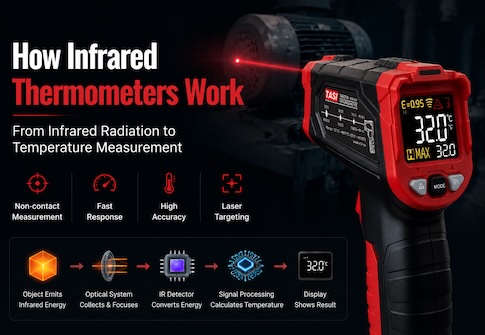
An infrared thermometer uses an optical system to collect infrared radiation from a defined field of view. The detector then converts the received radiant energy into a temperature value.
When the instrument is positioned close to perpendicular to a flat target, the projected measurement area is relatively compact. As the instrument is tilted, the same optical field is projected over a longer area.
In a simplified geometric model, if θ is the angle between the instrument's optical axis and the target surface normal, the projected dimension in the direction of tilt increases approximately in proportion to 1/cosθ.
At small angles, the change may be limited. At larger angles, however, the increase in projected area becomes increasingly significant.
Actual infrared thermometer optics are more complex than this simplified model, so the manufacturer's specified D:S ratio and field-of-view data should always be used for practical calculations.
The Measurement Area Becomes Elliptical
When an infrared thermometer is positioned close to perpendicular to a flat target, the measurement area can be approximated as circular.
At an oblique angle, the projected area becomes stretched in one direction and gradually becomes elliptical.
This has an important practical consequence: even if the laser remains positioned near the center of the target, part of the actual infrared measurement area may already extend beyond the target.
This is particularly important when measuring:
● Small pipes;
● Bearings;
● Electrical terminals;
● Components on printed circuit boards;
● Small heating elements.
If the field of view also includes the surrounding background, the displayed temperature represents the combined infrared energy received from the complete measurement area rather than the exact temperature at the laser point.
How Is Measurement Angle Related to the D:S Ratio?
D:S means Distance-to-Spot Ratio and describes the relationship between measurement distance and nominal spot diameter.
For example, for an infrared thermometer with a 12:1 D:S ratio, a measurement distance of approximately 1200 mm corresponds to a nominal spot diameter of about 100 mm under idealized conditions. Actual values may vary depending on the instrument's optical design and specified measurement distance.
D:S specifications are normally defined for the instrument's intended measurement geometry.
If the instrument is used at a significant angle:
● The measurement distance may remain unchanged;
● The instrument's internal optical field of view remains unchanged;
● But the area projected onto the target surface becomes larger.
Therefore, D:S alone is not sufficient when evaluating whether a small target can be measured reliably. The measurement angle must also be considered.
The Target Should Be Larger Than the Effective Measurement Area
A fundamental rule of infrared thermometry is that the target should fully cover the instrument's field of view.
If the target is smaller than the measurement area, the detector receives infrared radiation from both the target and its surroundings.
For example, a hot pipe may have an actual surface temperature of 120°C while the wall behind it is only 25°C. If excessive measurement distance or an oblique angle causes the field of view to include both surfaces, the indicated temperature may be significantly lower than the true pipe temperature.
The opposite can also occur when measuring a cooler target against a hotter background.
For reliable measurements, the target should preferably be clearly larger than the nominal measurement spot, allowing margin for distance, aiming, and angular effects.
Measurement Angle Can Also Affect Apparent Emissive Behavior
An ideal diffuse surface emits infrared radiation relatively uniformly over a broad range of viewing directions.
Real materials do not always behave this way. As the viewing direction moves farther from the surface normal, the directional emission and reflection characteristics of some materials can change.
This effect deserves particular attention on:
● Polished metal;
● Stainless steel;
● Aluminum;
● Copper;
● Chrome-plated surfaces;
● Smooth glass;
● Glossy plastics;
● Other low-emissivity or highly reflective materials.
As a result, a change in measurement angle may change the radiation received by the thermometer even when the emissivity setting remains unchanged.
Why Are Metal Surfaces More Sensitive to Viewing Angle?
Untreated shiny metals commonly have low emissivity and relatively high infrared reflectivity.
The infrared energy detected by the thermometer may therefore include not only radiation emitted by the target itself, but also infrared energy reflected from surrounding objects.
Possible sources include:
● Heating equipment;
● Furnaces;
● Hot pipes;
● People;
● Sun-heated surfaces;
● Other objects at significantly different temperatures.
Changing the viewing angle may change which surrounding heat sources are reflected toward the detector.
For this reason, the same spot on a polished metal surface can produce different readings when measured from different directions.
The cause is not necessarily an instrument fault. It may result from the combination of low emissivity and reflected ambient infrared radiation.
Does a Larger Angle Always Mean a Larger Error?
Not necessarily.
If the target:
● Is much larger than the measurement area;
● Has relatively high emissivity;
● Behaves approximately as a diffuse emitter;
● Has a uniform temperature distribution;
● Is not exposed to strong reflected hot or cold sources;
then moderate angular changes may produce only a limited effect.
Materials such as black rubber, painted surfaces, paper, and wood are generally more tolerant than polished metals under typical conditions.
However, as the viewing angle becomes increasingly oblique, uncertainty associated with spot enlargement, directional emissivity, and reflection generally increases.
For measurements that require good repeatability, a consistent viewing angle is therefore recommended.
Must the Instrument Always Be Held at Exactly 90°?
No. Infrared temperature measurements do not always require an exact 90° geometric orientation.
In industrial environments, machine geometry, piping, safety requirements, or access limitations may prevent perfectly perpendicular measurement.
In such cases:
● Avoid unnecessarily large viewing angles;
● Make sure the target still fully covers the measurement area;
● Prevent the field of view from including the background;
● Use the same position and angle when comparing repeated readings;
● Pay particular attention to reflected radiation on low-emissivity materials.
If the manufacturer specifies particular angular or optical requirements, those instructions should take priority.
Can the Laser Indicate Whether the Measurement Angle Is Correct?
Not by itself.
Single-laser and dual-laser systems are primarily used to assist with aiming.
Keep in mind that:
● The laser does not measure temperature;
● The infrared detector receives radiation from an area;
● The actual measurement area is usually much larger than the laser point;
● At an oblique angle, the effective measurement area may extend beyond the target even when the laser remains centered.
A laser point on the target therefore does not automatically mean that the measurement is valid.
Measurement distance, D:S ratio, target size, and viewing angle must all be considered together.
How to Control the Measurement Angle Correctly
To reduce errors related to viewing angle:
● Aim as directly as practical. Keep the optical axis close to the target surface normal whenever possible.
● Avoid excessive tilt. At large angles, verify that the entire field of view remains within the target.
● Reduce measurement distance. Moving closer to small targets generally reduces the nominal measurement spot.
● Check the D:S ratio. Optical performance differs between infrared thermometer models.
● Use a sufficiently large target. The target should preferably be larger than the nominal spot size.
● Minimize reflected background radiation. Pay particular attention when measuring polished metals and other low-emissivity surfaces.
● Keep conditions consistent. For repeated measurements, use approximately the same position, distance, and angle.
Why Is a Fixed Angle Important for Trend Monitoring?
In industrial maintenance, infrared measurements are often used to identify temperature changes over time rather than to obtain laboratory-level absolute temperature values.
Typical applications include monitoring:
● Motor housings;
● Bearings;
● Electrical equipment;
● Electrical connection points;
● HVAC ductwork;
● Heating systems.
If one measurement is taken nearly perpendicular to the target and the next is taken from a significantly different angle, the difference in readings may result from both a true temperature change and a change in measurement geometry.
For reliable trend analysis, measurement position, distance, and viewing direction should therefore be standardized as much as possible.
When Is Measurement Angle Especially Important?
Pay particular attention to viewing angle when:
● The target is small;
● The measurement distance is long;
● The instrument has a relatively low D:S ratio;
● The target is shiny metal;
● The target has low emissivity;
● Hot equipment is located nearby;
● The target and background have a large temperature difference;
● Measurements must be repeated over time;
● Temperature trends are being compared;
● Small localized hot spots are being investigated.
In these situations, measurement angle, distance, target size, emissivity, and reflected background radiation should all be evaluated together.
FAQ
Will an infrared thermometer always be inaccurate when used at an angle?
No. Small angular changes may have little effect when the target is large, has high emissivity, and has a uniform temperature. However, larger viewing angles increase the risk of spot enlargement, background inclusion, and reflection-related errors.
What is the preferred measurement direction?
Whenever practical, aim the optical axis close to perpendicular to the target surface.
Why can the same spot show different temperatures from different angles?
Possible causes include changes in the effective measurement area, background entering the field of view, directional emissivity, or reflected infrared radiation from surrounding heat sources.
Why can the reading still be incorrect when the laser is centered on the target?
Because the laser is only an aiming aid. The thermometer measures infrared radiation from a much larger optical area.
Which is more important: angle or distance?
Both matter. Distance affects the nominal spot size, while angle affects how that field of view is projected onto the target surface.
Why is a consistent angle particularly important on metal surfaces?
Shiny metals generally have low emissivity and high infrared reflectivity. Changing the viewing angle can therefore change the amount of ambient infrared radiation reflected toward the detector.
Conclusion
Measurement angle is an important factor affecting the stability and reliability of infrared temperature measurements.
At an oblique angle, the effective measurement area becomes larger and more elongated, increasing the possibility that surrounding surfaces enter the field of view. On reflective, low-emissivity materials, changing the angle may also change the amount of reflected ambient infrared radiation reaching the detector.
For reliable results, measurement angle should be considered together with measurement distance, D:S ratio, target size, emissivity, and reflected background radiation.
Whenever practical, aim the instrument close to perpendicular to the target and maintain consistent position, distance, and angle during repeated measurements. This improves measurement repeatability, comparability, and overall reliability.