Introduction
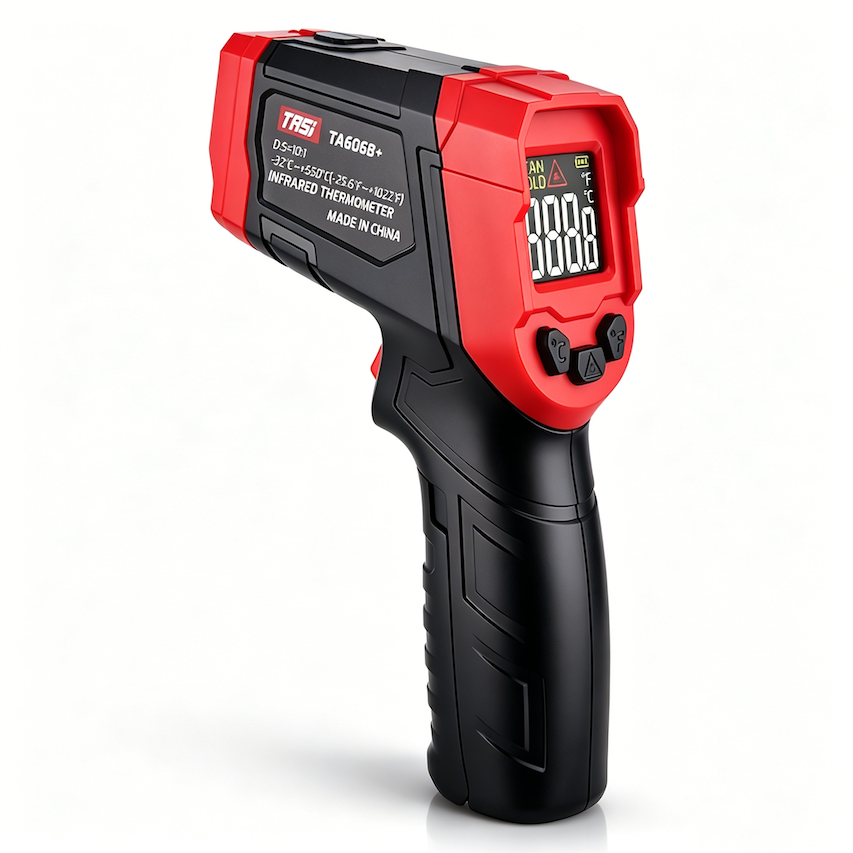
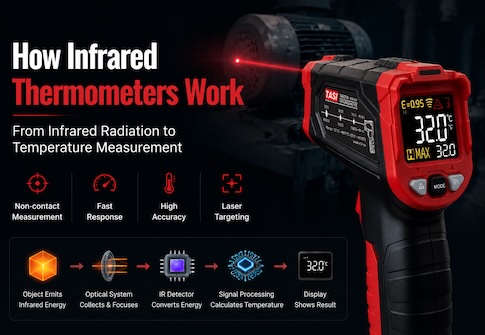
Infrared thermometers determine surface temperature by detecting the infrared energy emitted by an object. Because no physical contact is required, they are particularly suitable for measuring moving, rotating, hot, or difficult-to-access targets.
Typical industrial applications include products on conveyor belts, rotating rollers, operating machine components, moving films, paper, metal materials, and products travelling through production lines.
However, measuring a moving object involves more than simply pointing the thermometer at the target. Target speed, instrument response time, measurement spot size, measuring distance, surface condition, and measurement position can all influence the result. If these factors are not properly controlled, the instrument may measure a combination of the target temperature and the surrounding background temperature.
Key Points
● Infrared thermometers are particularly suitable for moving targets because the measurement is completely non-contact.
● The measurement spot must remain fully within the target area and should not include the background or adjacent objects.
● The faster the target moves, the more important the thermometer's response time becomes.
● Measurement distance should be selected according to the instrument's D:S distance-to-spot ratio and the size of the target.
● When measuring metals, plastic films, and other special surfaces, emissivity and reflected infrared radiation require particular attention.
● For periodically moving targets, measurements should be taken at the same position and angle to ensure meaningful comparison.
Why Are Infrared Thermometers Suitable for Moving Objects?
Contact temperature measurement normally requires a sensor to remain in stable physical contact with the target surface. This can be difficult or unsafe when the object is moving rapidly or rotating continuously.
A contact sensor may also be subject to mechanical wear, may interfere with the process, or may present a risk of entanglement around rotating equipment.
Infrared thermometers measure from a distance and provide several important advantages:
● No physical contact: Suitable for rotating, moving, and high-temperature objects.
● Fast response: Useful for production-line inspections and rapid temperature checks.
● No mechanical interference: The measurement does not affect the motion of the target.
● Improved operator safety: The operator does not need to place a probe directly onto moving equipment.
● Repeatable inspections: Different workpieces can be checked at the same fixed measurement point.
For these reasons, infrared temperature measurement is widely used in industrial maintenance, process monitoring, and quality control.
What Does the Infrared Thermometer Actually Measure?
An infrared thermometer measures the infrared radiation coming from the target surface within its field of view at a particular moment. It does not measure the temperature of the laser point itself.
Every infrared thermometer measures a defined area, commonly referred to as the measurement spot. As measurement distance increases, the spot generally becomes larger.
When a moving target passes through this measurement area, the reading mainly represents the target surface temperature if the entire spot remains within the target.
If the spot also covers the background, machine structure, or another object, the instrument receives infrared radiation from multiple surfaces. The displayed temperature can then be affected by all of them.
One of the most important rules for measuring moving objects is therefore:
The target area should be significantly larger than the actual measurement spot.
The visible laser should not be used to estimate the spot size. The laser is normally only an aiming aid and does not represent the full infrared measurement area.
Does Target Speed Affect the Measurement?
Yes, although the degree of influence depends mainly on the thermometer's response time and the amount of time the target remains within the measurement area.
An infrared thermometer requires a certain amount of time to respond to a change in incoming infrared radiation. This specification is generally referred to as the response time.
If the target remains inside the measurement area considerably longer than the instrument's response time, obtaining a stable reading is relatively straightforward.
If the target moves through the area too quickly, it may leave before the thermometer has responded sufficiently. The displayed value may therefore fail to represent the true target temperature, especially when there is a large temperature difference between the target and the background.
For example, if a hot workpiece moves rapidly past the measuring point while the background is much cooler, an instrument with insufficient response speed may indicate an intermediate temperature rather than the actual workpiece temperature.
For high-speed targets, a faster-response infrared thermometer should therefore be selected whenever possible.
How Should the Measurement Distance Be Selected?
Longer measurement distance is not automatically better.
Infrared thermometers typically specify their optical measurement capability using the D:S ratio — Distance-to-Spot Ratio.
For example, with a D:S ratio of 12:1, a measurement distance of approximately 1200 mm corresponds theoretically to a spot diameter of about 100 mm. Actual optical specifications should always be confirmed in the product documentation.
For moving objects, the target area should preferably be considerably larger than the measurement spot rather than only equal to it.
● Reduce the distance when measuring small moving workpieces.
● Larger rollers and conveyor surfaces can normally be measured from a greater distance.
● Small, fast-moving targets require particular attention to spot size.
● If the spot extends beyond the target edge, background temperature can influence the result.
The correct procedure is to determine the usable target area first and then select the measurement distance according to the instrument's D:S ratio.
Where Should You Aim When Measuring Rotating Objects?
For rollers, pulleys, rotating components, and similar equipment, select a surface area that is sufficiently large, visually accessible, and as consistent as possible.
Consider the following:
● Use a fixed measurement position whenever possible.
● Avoid target edges where the spot can overlap the background.
● Avoid excessively oblique viewing angles.
● Ensure that guards, brackets, or other machine structures do not enter the measurement spot.
● Maintain a safe working distance from high-speed rotating equipment.
When measurements are intended to monitor temperature trends, such as checking whether a roller is becoming progressively hotter, maintaining the same position, distance, angle, and emissivity setting is particularly important.
How Should Moving Products on a Conveyor Be Measured?
For products moving continuously along a production line, it is usually best to establish a fixed measurement location.
The infrared thermometer can then measure each workpiece as it passes through the same defined area while the measurement distance remains approximately constant.
For improved repeatability:
● Select a relatively large surface area on the product.
● Avoid measuring the product edge.
● Measure each workpiece at the same location.
● Keep the measurement distance consistent.
● For products made from the same material, maintain the same emissivity setting.
● For high-speed products, confirm that the thermometer's response time is suitable for the process.
This fixed-point method generally provides more comparable data than manually following each moving object with the thermometer.
Should the Thermometer Follow the Moving Target?
For large objects moving at low speed, it may be possible to follow the target briefly during measurement. However, manually tracking high-speed targets is generally not recommended.
When the instrument is moved continuously, measurement distance, angle, and target area may all change at the same time. As a result, individual readings may correspond to different areas and become difficult to compare.
For repeatable industrial inspection, the preferred method is:
Keep the measurement point fixed and allow the target to pass through it.
This approach is particularly effective on conveyor lines because all products can be measured under approximately the same geometric conditions.
Why Are Small, Fast-Moving Targets More Difficult to Measure?
Small, fast-moving targets create two simultaneous challenges: short target dwell time and limited measurement area.
If the measurement spot is larger than the target, the instrument may measure both the workpiece and the background.
Even if the spot is sufficiently small, the target may pass through the field of view faster than the thermometer can respond.
For these applications, evaluate:
● Instrument response time.
● D:S ratio and optical resolution.
● Whether the measurement distance can be reduced.
● Whether a fixed measurement position can be established.
● How long the target remains within the effective field of view.
If the target is significantly smaller than the measurement spot at the required working distance, improved aiming alone will not solve the problem. The distance must be reduced or an instrument with more suitable optical characteristics should be selected.
How Does Emissivity Affect Moving-Object Measurement?
Movement does not eliminate the effect of emissivity on infrared temperature measurement.
Rubber, coatings, plastics, wood, and many non-metallic surfaces are generally suitable for infrared measurement, although actual emissivity still varies by material and surface condition.
Shiny or polished metals can have low emissivity and may strongly reflect infrared radiation from surrounding heat sources. This can introduce substantial measurement error.
Therefore:
● Set emissivity appropriately for the target material.
● Avoid highly reflective or mirror-like areas when possible.
● Prevent strong external heat sources from being reflected into the thermometer.
● Use the same emissivity setting when comparing temperature trends under equivalent conditions.
If the actual surface emissivity is unknown, a single infrared reading should not automatically be treated as an exact absolute surface temperature.
Does the Laser Point Need to Follow the Target Continuously?
Not necessarily.
The laser on an infrared thermometer is primarily an aiming aid. It is not the temperature-sensing element.
For moving objects, it is more important to ensure that the complete infrared field of view remains within the required target area than to keep the laser precisely centred on one point.
At longer distances, the actual infrared measurement spot may be substantially larger than the visible laser point.
The D:S ratio should therefore be used to evaluate the true measurement area rather than assuming that the instrument measures only where the laser appears.
How Can Continuous Measurement Functions Help?
Some infrared thermometers provide continuous measurement, data hold, maximum value, minimum value, or similar functions. These can be useful when inspecting moving targets.
For example, when a series of products passes along a production line, continuous measurement or maximum-value capture may help identify unusually hot workpieces.
However, these functions only process measurements that the instrument has already obtained. They cannot compensate for an oversized measurement spot, incorrect emissivity, poor target positioning, or insufficient response speed.
Correct measurement conditions must therefore be established first.
Common Errors When Measuring Moving Objects
● Excessive measurement distance: The spot becomes too large and includes the background.
● Relying only on the laser point: The laser is mistaken for the actual measurement area.
● Target too small: The target does not fully cover the infrared field of view.
● Target too fast: The target passes before the instrument can respond adequately.
● Chasing the target with the thermometer: Distance and angle vary continuously, reducing repeatability.
● Ignoring emissivity: Different materials are measured using inappropriate or identical settings.
● Measuring at the edge: The spot overlaps the background.
● Ignoring reflected heat: Shiny surfaces may reflect infrared energy from heaters, furnaces, or other hot objects.
How Can Measurement Repeatability Be Improved?
In industrial inspection, the objective is often not only to determine one temperature value but also to compare products or monitor temperature changes over time.
Repeatability can be improved by standardising the measurement conditions:
● Use a fixed measurement position.
● Maintain a fixed measurement distance.
● Keep the measurement angle consistent.
● Use the same emissivity setting.
● Measure the same area of the target.
● Compare readings under similar operating conditions.
When these conditions remain consistent, temperature trends can often provide useful diagnostic information even where absolute temperature is still influenced by surface emissivity and other factors.
What Safety Precautions Are Required?
Infrared measurement is non-contact, but moving machinery still presents mechanical hazards.
● Do not place your hand or the instrument inside a hazardous rotating area simply to shorten the measurement distance.
● Do not bypass or reach through machine guards.
● Keep clothing, gloves, straps, and other loose objects away from shafts and drive components.
● Maintain an appropriate safety distance from hot, energised, or high-speed equipment.
● Never direct the aiming laser toward a person's eyes.
For high-speed rotating machinery, operator safety must take priority over achieving a shorter measurement distance.
If the required safe distance exceeds the optical capability of the thermometer, use an instrument with a higher D:S ratio or consider a fixed infrared temperature-monitoring system.
FAQ
Can an infrared thermometer measure a rotating object?
Yes. Infrared thermometers are particularly suitable for rollers, pulleys, rotating components, and other moving surfaces because no contact is required. The measurement spot, D:S ratio, response time, and emissivity must still be appropriate for the application.
Does a faster-moving object always produce a less accurate reading?
No. The important factor is whether the target remains within the effective measurement area long enough for the thermometer to respond. With adequate target size, sufficiently fast response, and stable measurement geometry, moving targets can be measured reliably.
Why does the reading fluctuate when measuring moving products?
Possible causes include the spot alternately covering the target and background, uneven target temperature, changes in emissivity, or excessive target speed. Reducing the measurement distance and using a fixed measurement position can often improve stability.
Does the measurement become correct as long as the laser is on the target?
No. The laser is only an aiming aid. The actual infrared measurement area is usually larger than the visible laser point. The D:S ratio should be used to determine whether the target fully covers the measurement spot.
Can infrared thermometers be used on high-speed production lines?
Yes, provided that target size, line speed, instrument response time, and optical resolution are suitable. Very small and very fast targets may require a higher-performance infrared instrument or fixed monitoring system.
Can a rotating metal shaft be measured accurately?
Caution is required. Bare, shiny metal surfaces often have low emissivity and can reflect infrared radiation from surrounding heat sources. The surface condition and emissivity must therefore be considered carefully, and another measurement method may be required for verification.
Conclusion
Infrared thermometers are well suited for measuring the surface temperature of conveyor products, rollers, rotating components, and other moving objects because they operate without physical contact.
Reliable measurement, however, depends on more than simply aiming at the target. Spot size, D:S ratio, response time, target speed, target dimensions, emissivity, and measurement position all affect the final result.
For best performance, use a fixed measurement position and consistent distance, ensure that the target completely covers the measurement spot, and verify that the instrument responds fast enough for the target speed.
For very small, fast-moving, or low-emissivity targets, the optical characteristics and measurement conditions require additional evaluation.
When measurement geometry, response speed, and surface radiation characteristics are properly controlled, infrared thermometers provide a fast, safe, and effective method for measuring moving objects.