Introduction
One of the main advantages of an infrared thermometer is its ability to measure surface temperature without physical contact. This often leads users to assume that the instrument can simply be used from a greater distance as long as it is pointed at the target.
In practice, however, greater measuring distance is not always better.
As the distance between the infrared thermometer and the target increases, the area covered by the instrument's field of view also becomes larger. If the target is too small to completely fill this measurement area, the thermometer may detect infrared radiation from both the target and surrounding surfaces, causing the displayed temperature to differ from the actual target surface temperature.
For this reason, correct infrared measurement depends not only on whether the instrument can “see” the target, but also on whether the target fully covers the measurement spot at the selected distance.
Key Takeaways
● The farther an infrared thermometer is from the target, the larger the measurement spot generally becomes.
● The appropriate measuring distance depends primarily on the instrument's D:S ratio and the size of the target.
● If the target is smaller than the measurement spot, surrounding surfaces may influence the reading.
● The laser pointer is primarily an aiming aid and does not represent the complete infrared measurement area.
● When measuring small targets, reduce the measuring distance so that the target fully covers the measurement spot.
● For hot equipment, moving machinery, or hazardous areas, measuring distance should balance optical requirements with operator safety.
Why Does the Measurement Area Increase with Distance?
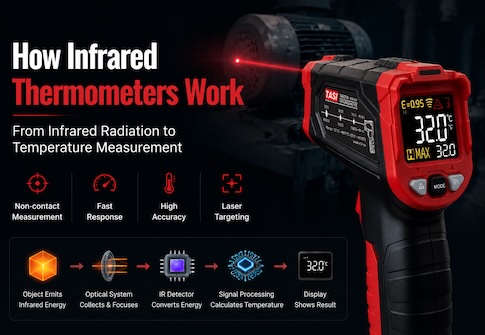
An infrared thermometer uses an optical system to collect infrared radiation emitted from a defined field of view. The detector and internal electronics then convert this radiation into a surface temperature reading.
The instrument does not normally measure an infinitely small point. Instead, it measures a defined area commonly referred to as the measurement spot.
As the thermometer moves farther away from the target, its field of view covers a larger area:
● At a short distance, the measurement spot is relatively small.
● As distance increases, the measurement spot becomes larger.
● At excessive distances, the measurement area may extend beyond the target itself.
This is why the same infrared thermometer may be suitable for measuring a large wall, pipe, or machine housing from a greater distance, while measurements of small wires, electronic components, or bearings usually require the instrument to be positioned closer to the target.
The D:S Ratio Determines the Practical Measuring Distance
One of the most important specifications for determining a suitable measuring distance is the D:S ratio, or Distance-to-Spot Ratio.
For example, if an infrared thermometer has a D:S ratio of 12:1, the ideal geometric relationship can be interpreted approximately as follows:
● At a distance of 120 mm, the measurement spot is approximately 10 mm in diameter.
● At a distance of 600 mm, the measurement spot is approximately 50 mm in diameter.
● At a distance of 1200 mm, the measurement spot is approximately 100 mm in diameter.
This demonstrates that as measuring distance increases, the area from which the instrument receives infrared radiation also becomes larger.
A higher D:S ratio generally provides a smaller measurement spot at the same distance, making the thermometer more suitable for measuring relatively small targets from farther away.
However, the D:S ratio describes the optical field-of-view relationship. For actual measurements, always refer to the specific instrument's operating manual and distance-to-spot diagram.
What Is the Most Common Problem When Measuring from Too Far Away?
The primary problem with excessive measuring distance is not that the infrared signal suddenly disappears. Instead, the measurement area may become larger than the target.
Consider measuring the temperature of a relatively narrow hot-water pipe. If the measurement spot at the selected distance is wider than the pipe, the thermometer may receive infrared radiation from:
● The pipe surface;
● The wall behind the pipe;
● Nearby equipment;
● Other surfaces within the instrument's field of view.
The displayed temperature will then be influenced by the combined infrared radiation within the measurement area rather than representing only the actual surface temperature of the pipe.
The greater the temperature difference between the target and its background, the more noticeable this effect can become.
Does Measuring from Too Far Away Always Produce a Lower Temperature?
No.
Whether the reading becomes higher or lower depends mainly on the temperature of the surfaces surrounding the target.
For example:
● When measuring a hot pipe against a cooler wall, including the background in the measurement area may cause the displayed temperature to be lower.
● When measuring a cooler target surrounded by hotter equipment, the reading may become higher.
● If the target and background are at similar temperatures, the effect of excessive distance may be difficult to detect immediately.
Therefore, it is incorrect to assume that greater distance always causes a lower reading.
The real issue is that an excessive measuring distance may change what the instrument is actually measuring—from a single target to a combination of the target and surrounding surfaces.
If the Laser Is Pointing at the Target, Is the Measurement Correct?
Not necessarily.
Many infrared thermometers include a laser pointer to help the operator aim the instrument. The laser indicates the approximate aiming position, but the laser itself does not perform the temperature measurement.
The actual temperature measurement is based on the area covered by the infrared optical system, not simply the laser dot.
At longer measuring distances, the laser may still be positioned precisely in the center of the target while the actual measurement spot has already become significantly larger than the target.
When using laser aiming, therefore, consider all of the following:
● Is the laser correctly aimed at the target?
● How large is the measurement spot at the current distance?
● Is the target large enough to fully cover the measurement area?
A laser dot positioned on the target alone does not guarantee that the measuring distance is appropriate.
How Much Larger Should the Target Be Than the Measurement Spot?
In practical applications, the target should not merely match the theoretical diameter of the measurement spot.
To reduce the effects of aiming error, hand movement, target edges, and variations in the optical field of view, it is preferable for the target area to be clearly larger than the measurement spot.
For example, if the theoretical spot diameter is approximately 50 mm at the selected distance, the target should ideally provide a continuous and uniform surface area noticeably larger than 50 mm.
For smaller targets:
● Reduce the distance between the thermometer and the target.
● Select an infrared thermometer with a higher D:S ratio.
● Aim toward the central area of the target whenever possible.
● Avoid allowing the measurement spot to extend onto surrounding surfaces.
The exact safety margin should be determined according to the instrument manual, target dimensions, and required measurement accuracy.
Does Measuring Closer Always Improve Accuracy?
Not necessarily.
Provided that the target fully covers the measurement spot, reducing the distance is generally helpful when measuring small targets. However, measuring distance is not the only factor that determines infrared measurement accuracy.
Other factors include:
● Target emissivity settings;
● Surface material;
● Highly reflective surfaces;
● Cleanliness of the optical lens;
● Changes in ambient temperature;
● Steam, smoke, dust, or other interference in the optical path;
● The instrument's specified accuracy and response characteristics.
The correct approach is therefore not simply “the closer, the better.” Instead, select a reasonable measuring distance that allows the target to fully fill the instrument's field of view while maintaining safe operating conditions.
What Should Be Considered During Long-Distance Measurements?
Some industrial applications require the operator to remain at a certain distance from the target, such as when measuring high-temperature equipment, rotating machinery, electrical installations, or other areas that are difficult or unsafe to approach.
In these situations:
● Estimate or calculate the maximum practical distance according to the target size.
● Check the instrument's D:S ratio.
● Ensure that the target is clearly larger than the measurement spot at the selected distance.
● Aim at the center of the target and avoid target edges whenever possible.
● For small targets, select a model with a higher D:S ratio rather than simply increasing the measuring distance.
● When working near high-temperature or hazardous equipment, always follow applicable site safety procedures rather than moving closer solely to reduce the spot size.
The correct measuring distance is ultimately a balance between measurement requirements, target dimensions, and operator safety.
FAQ
How far can an infrared thermometer measure?
There is no universal maximum distance for all infrared thermometers. The practical measuring distance depends on the instrument's D:S ratio, the size of the target, and the required measurement accuracy. Large targets can generally be measured from farther away, while small targets require a shorter distance or a higher D:S ratio.
Will an infrared thermometer stop detecting the target if it is too far away?
Not necessarily. The more common problem is that the measurement spot becomes too large as distance increases, causing surrounding surfaces to enter the field of view and influence the temperature reading.
Why is the temperature inaccurate even though the laser dot is on the target?
The laser is primarily an aiming aid and does not represent the complete infrared measurement area. Even when the laser dot is on the target, the measurement spot may be larger than the target and may include background surfaces.
What does 12:1 mean on an infrared thermometer?
A D:S ratio of 12:1 describes the approximate relationship between measuring distance and spot diameter. Under ideal geometric conditions, at a distance of 1200 mm, the measurement spot would be approximately 100 mm in diameter. Always refer to the manufacturer's optical specifications for the actual instrument.
How should small electronic components be measured?
Reduce the measuring distance so that the measurement spot remains smaller than the target area. For very small targets, consider an infrared thermometer with a higher D:S ratio or another temperature measurement method better suited to small components.