Introduction
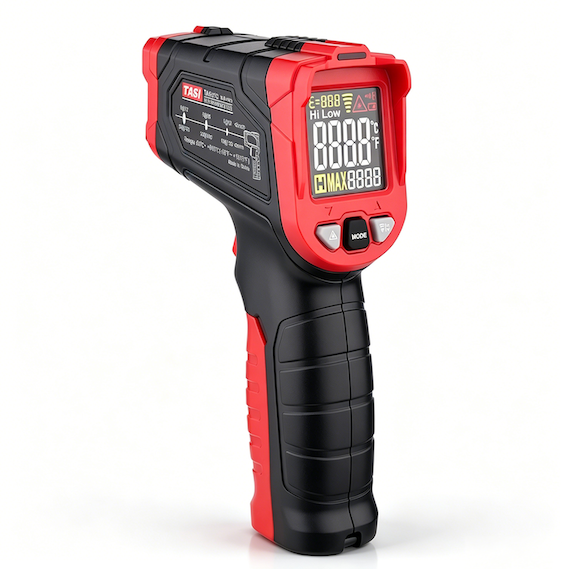
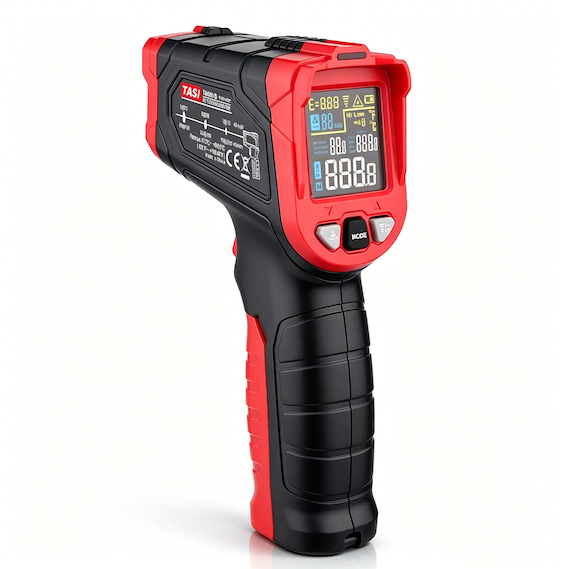
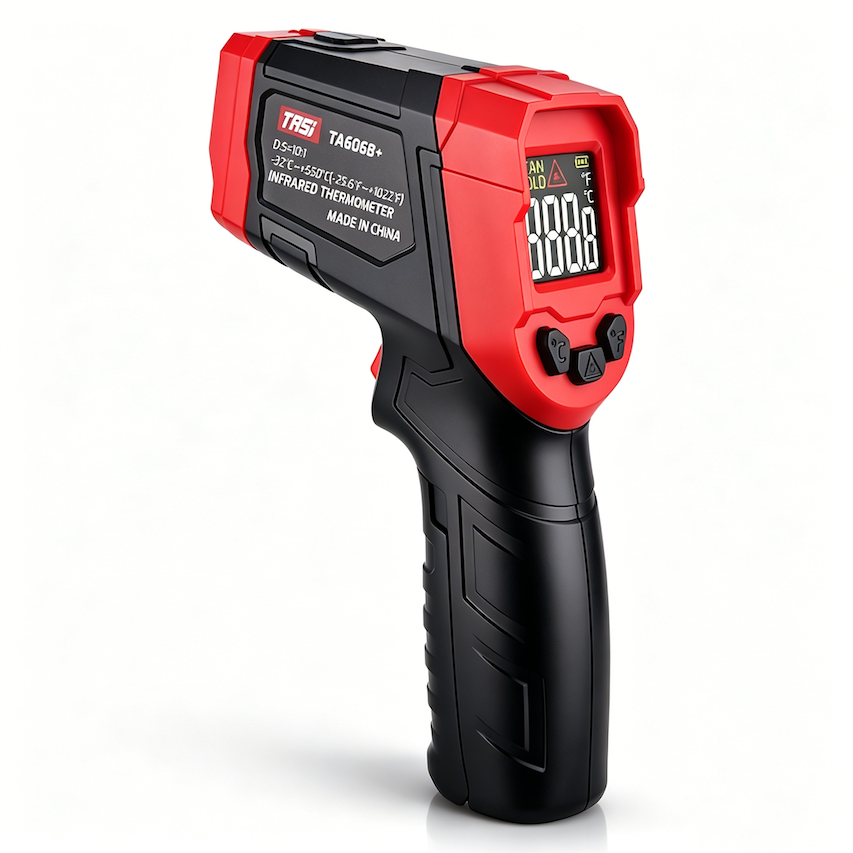
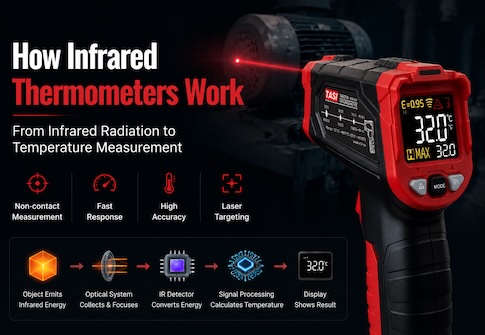
Infrared thermometers measure infrared radiation emitted from an object’s surface without requiring physical contact. One of the most common questions in practical use is: how far should the infrared thermometer be from the target?
There is no single “best measuring distance” that applies to every application. The appropriate distance depends primarily on the instrument’s D:S ratio, the size of the target, the required measurement area, and the surrounding environment.
If the distance is too great, the thermometer may receive infrared radiation from both the intended target and the surrounding background. The displayed temperature may therefore no longer accurately represent the target itself. When selecting an infrared thermometer, it is important to consider not only temperature range and accuracy, but also whether its optical resolution is suitable for the required working distance.
Key Takeaways
● Measuring distance should be determined together with the target size and the thermometer’s D:S ratio.
● A higher D:S ratio generally produces a smaller measurement spot at the same distance, making it more suitable for distant or relatively small targets.
● The effective target area should be larger than the measurement spot to minimize background interference.
● The laser is primarily an aiming aid and does not represent the actual infrared measurement spot.
● Measuring closer does not automatically guarantee better accuracy; optical design, specified working conditions, and site conditions must also be considered.
● For small components, distant equipment, or high-temperature targets, a higher D:S ratio is often preferable.
What Does Measuring Distance Mean for an Infrared Thermometer?
The measuring distance is the distance between the infrared receiving optics of the thermometer and the surface being measured.
An infrared thermometer does not measure an infinitely small point. Instead, it collects infrared radiation from a defined area. As the distance between the instrument and the target increases, the measurement area generally becomes larger.
This means:
● At a shorter distance, the measured area is generally smaller.
● As distance increases, the measurement spot normally becomes larger.
● If the spot extends beyond the target, surrounding surfaces may influence the reading.
● The displayed temperature may then represent the combined infrared radiation from the target and its surroundings.
The key question is therefore not simply “How far can the thermometer measure?” but whether the target can completely cover the measurement spot at the selected distance.
Why Does the D:S Ratio Determine Measuring Distance?
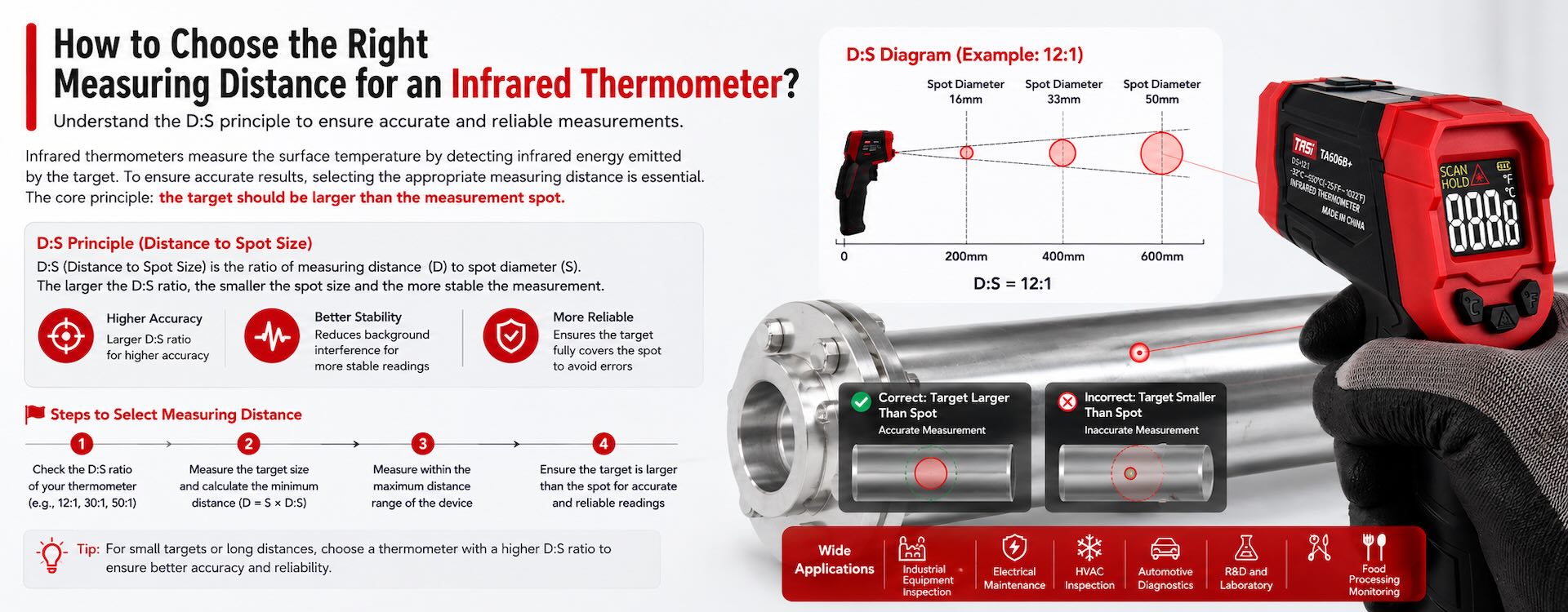
D:S stands for Distance-to-Spot Ratio. It describes the relationship between the measuring distance and the diameter of the measurement spot and is an important indicator of an infrared thermometer’s optical resolution.
For example, for an infrared thermometer with a D:S ratio of 12:1, under simplified theoretical conditions:
● At approximately 120 mm, the spot diameter is about 10 mm.
● At approximately 600 mm, the spot diameter is about 50 mm.
● At approximately 1200 mm, the spot diameter is about 100 mm.
The relationship can be estimated as:
Spot diameter ≈ Measuring distance ÷ D:S ratio
This simplified calculation is useful for understanding the relationship between distance and spot size. Actual optical characteristics, minimum spot size, and focusing behavior can vary between instruments. For practical measurements, always refer to the D:S diagram and specifications provided for the specific model.
How Should Different D:S Ratios Be Selected?
A higher D:S ratio does not automatically mean higher temperature accuracy. Instead, it indicates better spatial resolution when measuring smaller targets from a greater distance.
Typical applications include:
● 10:1: Suitable for general close-range measurements, HVAC inspection, household appliances, and relatively large surfaces.
● 12:1: Commonly used for industrial maintenance, electrical inspection, machinery, and general-purpose non-contact temperature measurement.
● 50:1: Suitable for industrial applications where a greater safety distance is required while measuring relatively small targets.
● 80:1: Better suited to long-distance measurements, smaller targets, or certain high-temperature applications.
For large walls, pipes, equipment housings, or similarly large surfaces, an extremely high D:S ratio is usually unnecessary.
If electrical connections, mechanical components, small hot spots, or inaccessible equipment must be measured from a considerable distance, a higher D:S ratio can provide a significant advantage.
Selecting Measuring Distance According to Target Size
The first step is to determine the size of the actual area that needs to be measured.
For example, consider a pipe approximately 30 mm in diameter. If the measurement spot has already expanded to 50 mm at the selected distance, the thermometer may receive infrared radiation not only from the pipe but also from the wall or other surfaces behind it.
Even if the laser is aimed precisely at the center of the pipe, the displayed temperature may still be affected.
A fundamental measurement principle is therefore:
The effective target area should be larger than the measurement spot.
In practical engineering applications, additional margin is generally recommended to reduce aiming errors and edge interference. For example, the target area may be selected to be substantially larger than the spot, and in some situations a target area around twice the spot diameter provides a useful operating margin. The appropriate margin should always be determined according to the instrument’s optical specifications and actual measurement conditions.
What Happens If the Measuring Distance Is Too Great?
When an infrared thermometer is used beyond an appropriate working distance, the most common problem is not that it stops displaying a temperature. Instead, the displayed value may no longer accurately represent the intended target.
Possible effects include:
● The measurement spot becomes larger than the target.
● Surrounding surfaces enter the instrument’s field of view.
● Small hot or cold spots become averaged with the surrounding area.
● Positioning accuracy decreases when measuring electrical terminals, pipes, or small components.
● Over longer distances, water vapor, smoke, dust, and other atmospheric conditions may also affect infrared transmission.
For example, if a small electrical terminal is significantly hotter than the surrounding equipment enclosure, excessive measuring distance may cause both areas to enter the field of view. The resulting temperature reading can therefore be lower than the actual surface temperature of the terminal.
Is Measuring Closer Always Better?
Not necessarily.
When the target fully covers the measurement spot, reducing the distance can often help minimize background interference. However, this should not be interpreted as “the closer, the more accurate.”
Some infrared thermometers have a specific optical design, minimum spot size, focusing distance, or recommended working distance. Measuring too close may therefore move the instrument outside its intended optical conditions.
Safety distance must also be considered when measuring:
● Furnaces and other high-temperature equipment.
● High-temperature pipes.
● Rotating machinery.
● Energized electrical equipment.
● Moving components that cannot be approached safely.
● Areas involving thermal, mechanical, or electrical hazards.
The correct approach is to maintain the required safety distance while selecting a distance at which the target adequately covers the measurement spot according to the D:S ratio and target dimensions.
Does the Laser Indicate the Actual Measurement Area?
The laser on an infrared thermometer is primarily used as an aiming aid.
The laser generally does not participate in the temperature measurement itself, and the size of the laser point should not be interpreted as the size of the infrared measurement area.
The actual measurement area is determined by the infrared optical system and the D:S ratio.
Therefore, even if the laser is aimed accurately at a small target, the thermometer may still receive radiation from surrounding areas if the infrared spot is larger than the target.
Some instruments use single-laser, dual-laser, or other aiming systems. Because these systems may indicate the measurement area differently, users should follow the instructions for the specific model.
How Should Measuring Distance Be Selected for Different Applications?
For large targets such as equipment housings, walls, and floors, the target is generally much larger than the measurement spot. Measuring distance can therefore be adjusted over a relatively wide range, provided the instrument is operated within its specified conditions and the target continues to cover the spot.
For smaller targets such as pipes, motor bearing areas, and electrical connections, the D:S ratio becomes more important. Excessive distance can easily cause surrounding structures to enter the measurement area. In these cases, either reduce the distance or select an infrared thermometer with a higher D:S ratio.
For furnaces, high-temperature equipment, and targets that cannot be approached safely, first determine the required safety distance. Then use the target size to estimate the D:S ratio needed. These applications often benefit from higher optical resolution.
For very small electronic components, even a handheld infrared thermometer with a high D:S ratio may be limited by its minimum spot size. In such applications, minimum spot specifications should be evaluated rather than relying only on maximum measuring distance.
How to Select an Infrared Thermometer Based on Working Distance
During product selection, first determine the typical working distance and the smallest target area that needs to be measured.
For example, if a target approximately 50 mm in diameter must be measured from a distance of 1 meter:
1000 ÷ 50 = 20
From a simplified geometrical perspective, a D:S ratio of approximately 20:1 would be required to keep the theoretical spot diameter at around 50 mm.
In practice, however, the measurement spot should not be allowed to exactly match the target size. Hand movement, viewing angle, distance variation, and target edges can all introduce additional measurement uncertainty.
Additional margin should therefore be retained. At the same 1-meter distance and 50-mm target size, a higher D:S ratio provides a smaller spot and allows the target to cover the field of view more reliably.
For this reason, when comparing infrared thermometers, determine working distance and minimum target size first, and then decide whether a 10:1, 12:1, 50:1, 80:1, or other optical configuration is appropriate.
What Other Specifications Should Be Considered?
The D:S ratio determines the approximate size of the area measured at a given distance, but it does not represent the overall performance of an infrared thermometer.
Other important specifications include:
● Temperature range suitable for the expected minimum and maximum temperatures.
● Measurement accuracy appropriate for the application.
● Adjustable emissivity where required.
● Response time suitable for rapidly changing targets.
● Spectral response suitable for the material being measured.
● Operating ambient temperature compatible with the working environment.
● Functions such as high/low alarms, maximum/minimum values, and data hold where required.
Low-emissivity or highly reflective surfaces, particularly some metals, can produce significant errors even when the measuring distance is correct if the emissivity setting is inappropriate.
The D:S ratio should therefore be evaluated together with emissivity, accuracy, temperature range, and environmental conditions.
FAQ
What is the maximum distance of an infrared thermometer?
There is no meaningful maximum distance based on distance alone. Although infrared radiation can be detected from relatively far away, the measurement spot becomes larger as the distance increases. Practical working distance depends on the D:S ratio, target size, environmental conditions, and the instrument’s optical specifications.
Is a higher D:S ratio always better?
No. A higher D:S ratio is advantageous for smaller targets and longer distances, but it is not necessarily required for large targets or close-range measurements. The appropriate ratio should be selected according to the application.
Can a 12:1 infrared thermometer measure from 1 meter away?
Yes, provided the target is sufficiently large. At approximately 1 meter, the theoretical spot size is already several centimeters in diameter. The effective target area should therefore be clearly larger than the spot. Refer to the product’s D:S diagram for exact guidance.
Does accurate laser aiming guarantee an accurate reading?
No. The laser is an aiming aid, while the infrared optical system determines the actual measurement area. If the spot is larger than the target, surrounding surfaces can still influence the reading.
For small targets, should I move closer or choose a higher D:S ratio?
Both approaches can improve target coverage. If it is safe and practical to move closer, reducing the distance may help. If a greater distance must be maintained, select a thermometer with a higher D:S ratio.
Does measuring distance affect the specified accuracy?
Specified accuracy is normally defined under stated test conditions. Distance alone does not directly change the accuracy specification, but if increased distance causes the spot to exceed the target or introduces background and atmospheric interference, actual measurement error can increase significantly.
Conclusion
Selecting the correct measuring distance for an infrared thermometer is essentially a matter of matching working distance, D:S ratio, and target size.
For relatively large targets, standard 10:1 or 12:1 infrared thermometers are suitable for many general and industrial applications. For smaller targets that must be measured from greater distances, 50:1, 80:1, or other higher D:S configurations may be more appropriate.
Always ensure that the effective target area fully covers the measurement spot, and remember that the laser does not represent the actual infrared measurement area. For long-distance, high-temperature, small-target, or demanding industrial applications, determine the required working distance and minimum target size first, then evaluate the D:S ratio together with temperature range, accuracy, emissivity, and environmental conditions.
Only when the measuring distance is properly matched to the instrument’s optical performance can an infrared thermometer provide stable and representative surface-temperature measurements.