Introduction
A standard infrared thermometer provides fast, non-contact temperature measurements. However, when measurements must be recorded continuously, collected from multiple points, or retained for later analysis, manual transcription can become inefficient.
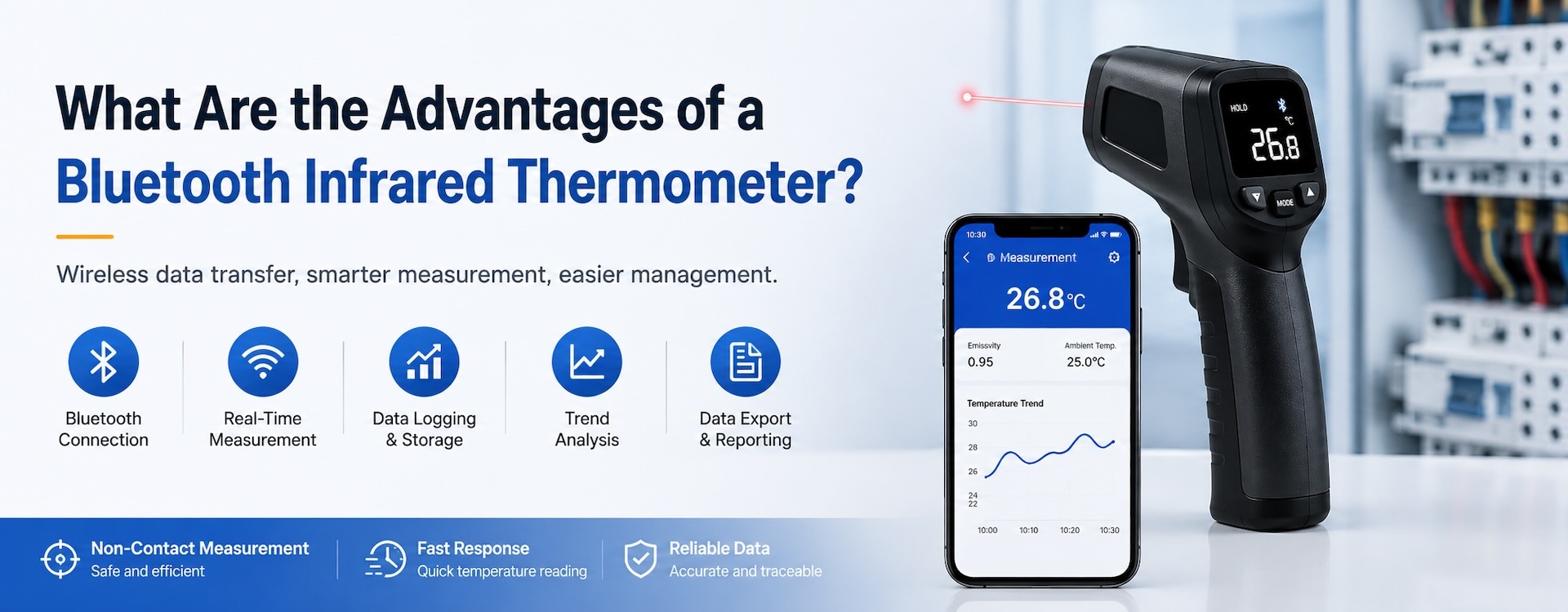
A Bluetooth infrared thermometer adds wireless communication, allowing measurement results to be transmitted to a smartphone, tablet, or other compatible smart device. Depending on the accompanying application, users may be able to view, record, organize, analyze, and export temperature data.
The main value of Bluetooth connectivity is therefore not simply the ability to connect the instrument to a phone. Its real advantage is more efficient temperature data management. For applications involving multiple measurement points, routine equipment inspections, temperature trend monitoring, or report preparation, Bluetooth functionality can provide significant practical benefits.
Key Points
● The main advantage of a Bluetooth infrared thermometer is wireless transmission and digital management of measurement data.
● It reduces manual data entry and improves efficiency during multi-point measurements and equipment inspections.
● With compatible software, users may be able to store readings, view temperature trends, manage measurement records, and export data.
● For occasional or simple temperature checks, a conventional infrared thermometer may already be sufficient.
● Bluetooth connectivity should not replace consideration of essential parameters such as temperature range, accuracy, D:S ratio, emissivity, and software capabilities.
What Is a Bluetooth Infrared Thermometer?
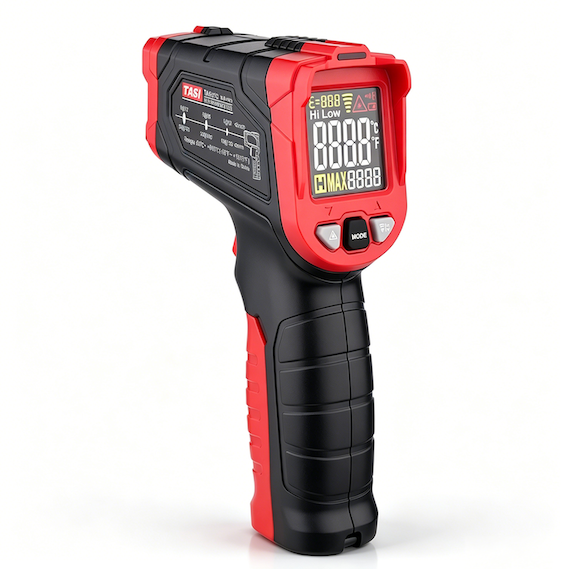
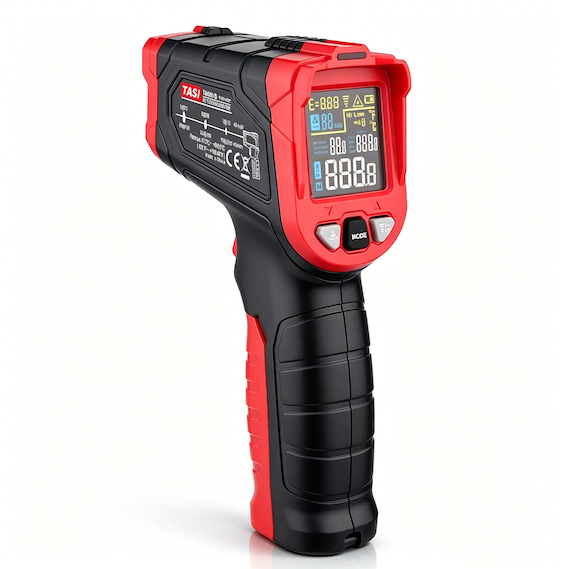
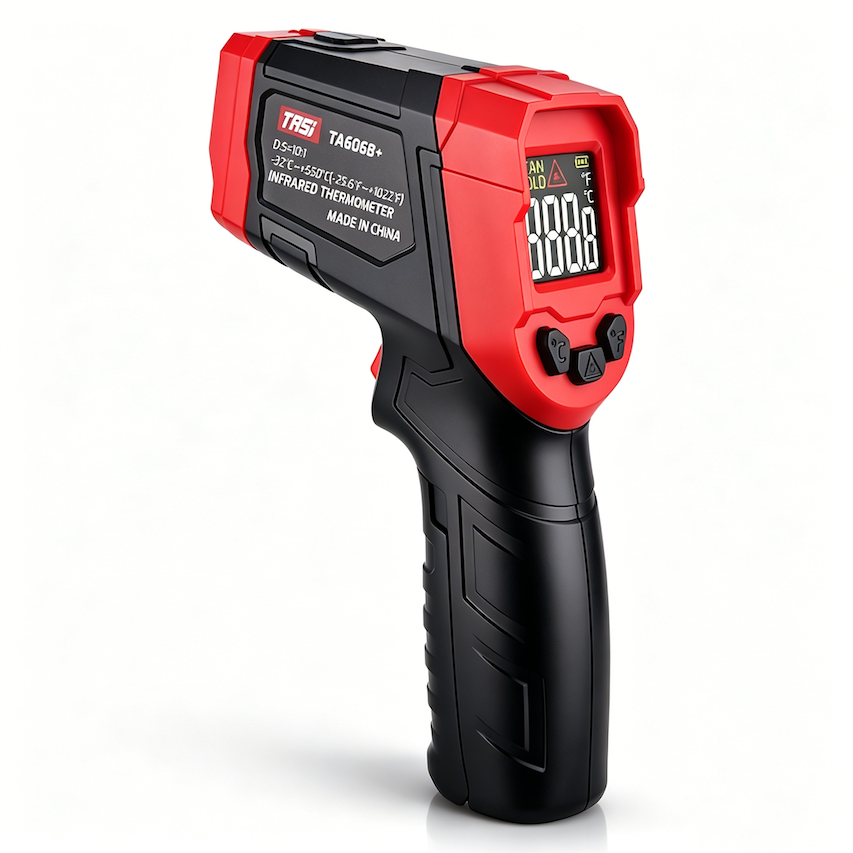
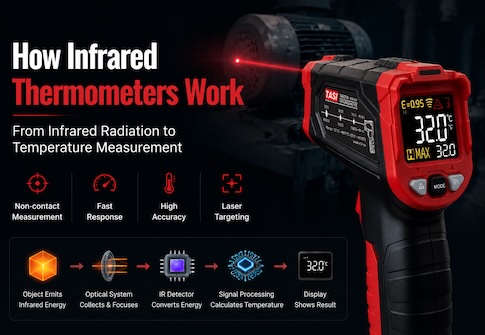
A Bluetooth infrared thermometer is fundamentally a non-contact temperature measuring instrument. It detects infrared radiation emitted from the surface of a target and converts the received signal into a temperature reading through its optical system, sensor, and internal electronics.
The main difference from a conventional infrared thermometer is the addition of a Bluetooth communication module. Measurement results can therefore be shown on the instrument display and transmitted wirelessly to a compatible smartphone, tablet, or other smart device.
Depending on the product and software design, the connected device may support real-time temperature display, measurement history, data lists, trend graphs, data storage, and export functions.
Bluetooth itself does not directly improve measurement accuracy. Measurement performance still depends primarily on the sensor, optical system, stated accuracy, D:S ratio, emissivity setting, environmental conditions, and correct measurement technique.
What Are the Main Advantages of a Bluetooth Infrared Thermometer?
The greatest advantage of Bluetooth connectivity is that individual temperature readings can be converted into data that is easier to store, organize, and analyze.
● Wireless data transmission
Measurement results can be transferred directly to a smartphone or tablet without a data cable. This is particularly convenient for mobile inspection work where the operator moves frequently between measurement locations.
● Less manual recording
With a conventional instrument, users often need to read the display and write down each result manually. When many measurement points are involved, this can be time-consuming and may lead to omitted, incorrectly copied, or incorrectly assigned readings. Bluetooth transfer helps reduce repetitive manual data entry.
● Convenient storage of historical measurements
If the companion application supports data storage, measurements from different times can be retained for later comparison. Historical records are often more useful for maintenance activities than a single temperature reading.
● Temperature trend monitoring
Some applications can present successive readings as charts or trend curves. During equipment heating, cooling, or operating-condition checks, this makes temperature changes easier to evaluate than individual readings alone.
● Improved efficiency for multi-point inspections
Electrical equipment, HVAC systems, machinery, and production equipment often require many temperature checks during a single inspection. Bluetooth connectivity can streamline the measuring, reading, recording, and organizing process.
● Easier subsequent analysis and reporting
Where supported by the software, data may be exported in formats such as CSV or Excel for maintenance records, asset files, trend analysis, or internal inspection reports. Available export formats depend on the specific instrument and application.
How Does Bluetooth Help with Equipment Inspections?
Routine equipment inspection is one of the most practical applications for a Bluetooth infrared thermometer.
For example, maintenance personnel may need to inspect several motors, electrical panels, bearings, pipe connections, or HVAC components. With a conventional infrared thermometer, each reading may need to be manually matched with the equipment name, measurement location, and measured temperature.
When dozens of points are involved, data recording can become a substantial part of the inspection process.
A Bluetooth infrared thermometer can transmit readings to a smart device. If the associated application provides suitable data management functions, users can store and compare measurement results more efficiently.
For example, a machine may normally operate within a stable temperature range. If its measured temperature gradually increases over successive inspections, the trend may provide useful maintenance information even before a defined alarm threshold is exceeded.
For equipment inspection, Bluetooth therefore helps move the process from simple spot temperature checks toward structured temperature data management.
What Is the Difference Between a Bluetooth Infrared Thermometer and a Standard Infrared Thermometer?
Both types use essentially the same infrared temperature measurement principle. The main difference lies in communication and data management.
| Comparison Item | Standard Infrared Thermometer | Bluetooth Infrared Thermometer |
|---|---|---|
| Non-contact temperature measurement | Yes | Yes |
| Instrument display | Yes | Yes |
| Smartphone/tablet connection | Usually no | Yes |
| Wireless data transfer | Usually no | Yes |
| Historical data management | Depends on model | Usually more convenient |
| Temperature trend viewing | Usually limited | Possible with compatible software |
| Multi-point data organization | More manual work | More efficient |
| Purchase cost | Generally lower | Generally higher |
A Bluetooth model should therefore not automatically be considered more accurate. Bluetooth mainly improves data communication and workflow, while measurement accuracy depends on the technical performance of the thermometer itself.
When Is a Bluetooth Infrared Thermometer the Better Choice?
The decision mainly depends on whether the measurement data needs to be stored, compared, or managed after measurement.
Bluetooth functionality is particularly useful when:
● Many pieces of equipment or measurement points are inspected regularly.
● Measurement results need to be retained.
● Temperature readings from different inspection dates must be compared.
● Continuous temperature changes or trends need to be observed.
● Measurement data is used in maintenance records or internal reports.
● Manual transcription and repeated data entry need to be reduced.
● Measurements need to be reviewed centrally on a smartphone or tablet.
Typical applications include industrial equipment maintenance, electrical inspection, HVAC servicing, machinery inspection, and production-process temperature checks.
When Is a Standard Infrared Thermometer Sufficient?
Bluetooth is not necessary for every application.
If the infrared thermometer is mainly used for occasional spot checks and only the current temperature is required, a conventional model may be entirely adequate.
Examples include:
● Occasional HVAC outlet temperature checks.
● Quick checks for abnormal equipment surface heating.
● General household or maintenance temperature measurements.
● Applications with only a small number of readings and no historical data requirement.
● Situations where data does not need to be transferred to a computer or mobile device.
In these cases, the available budget may be better allocated to a more suitable temperature range, higher measurement accuracy, or a larger D:S ratio rather than Bluetooth connectivity.
What Specifications Should Be Considered When Selecting a Bluetooth Infrared Thermometer?
Bluetooth connectivity should not distract from the core specifications that determine whether the instrument is suitable for the intended measurement task.
● Temperature range
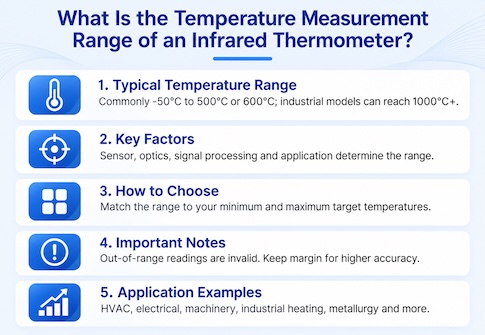
Ensure that the minimum and maximum measurable temperatures cover the intended application. General maintenance and high-temperature industrial applications may require very different ranges.
● Measurement accuracy
Where temperature determines process acceptance or alarm conditions, check the specified accuracy within the actual operating temperature range rather than focusing only on the maximum measurable temperature.
● D:S ratio
The distance-to-spot ratio determines the size of the measurement area at a given distance. Smaller targets or longer measurement distances generally require a higher D:S ratio.
● Emissivity setting
Different materials have different infrared emission characteristics. For metals, plastics, coatings, rubber, and other materials, adjustable emissivity can help improve measurement reliability.
● Response time
A fast response is useful when many targets must be checked in succession and can improve inspection efficiency.
● Bluetooth communication range
Actual wireless range may be affected by the smartphone model, walls, machinery, and the electromagnetic environment. Maximum range under ideal conditions should not be treated as the only performance criterion.
● Companion software functions
The practical value of a Bluetooth thermometer depends heavily on its application. Check whether the software supports real-time display, history, trend graphs, data storage, and the required export functions.
● Operating system compatibility
Before purchase, confirm compatibility with the required Android, iOS, or other operating system versions and verify that the intended smartphone or tablet can install and run the application.
Does Bluetooth Improve Infrared Temperature Measurement Accuracy?
Not directly.
Bluetooth is a communication function and normally does not change the infrared measurement principle. Accuracy is primarily affected by the instrument specification, target emissivity, measurement distance, target size, ambient conditions, optical system, and correct operating technique.
For example, even if an instrument records every reading automatically through Bluetooth, results can still be inaccurate if the target does not fully fill the measurement spot because the instrument is positioned too far away.
Bluetooth improves data management. It does not compensate for incorrect measurement conditions.
What Should Be Considered When Using a Bluetooth Infrared Thermometer?
● Confirm that Bluetooth is enabled on the smartphone or tablet and that the instrument is correctly connected to the application.
● Before an important inspection, perform a test measurement to confirm that data can be transmitted and stored correctly.
● For extended data logging, monitor the remaining battery capacity of both the thermometer and the mobile device.
● Do not focus only on the data shown in the application; measurement distance, target size, and emissivity must still be set correctly.
● Near large motors, variable-frequency drives, or equipment that may generate significant electromagnetic interference, check wireless connection stability.
● If the data will be used in formal inspection records, verify the application’s storage and export functions in advance.
FAQ
Does a Bluetooth infrared thermometer have to be connected to a smartphone to work?
Usually not. Most models can still operate as conventional stand-alone infrared thermometers without a smartphone connection, although this depends on the product design.
Does Bluetooth slow down temperature measurement?
Normally no. Infrared temperature measurement is performed inside the instrument, while Bluetooth primarily transmits the resulting data to the connected device.
Is a Bluetooth infrared thermometer more accurate than a standard model?
Not necessarily. Bluetooth capability does not directly determine accuracy. The specified accuracy and optical characteristics of each model should be compared.
Can Bluetooth be used without an internet connection?
Bluetooth communication itself generally does not require internet access. However, application installation, account login, cloud synchronization, or certain software functions may require a network connection.
Can a Bluetooth infrared thermometer be used for continuous temperature logging?
If both the instrument and the application support continuous sampling and recording, it can be used for temperature trend monitoring. For long-term, high-frequency, fixed-point monitoring, sampling interval, battery life, and storage capacity should be evaluated, and a dedicated data logging system may be more suitable.
What should be prioritized when buying a Bluetooth infrared thermometer?
First confirm that the temperature range, accuracy, D:S ratio, and emissivity capabilities meet the measurement requirements. Then evaluate Bluetooth stability, software compatibility, data logging, and export functions.
Conclusion
The primary advantage of a Bluetooth infrared thermometer is not a different temperature measurement method, but more efficient transmission, recording, storage, and analysis of temperature data.
For users performing frequent measurements, routine inspections, historical comparisons, or temperature trend analysis, Bluetooth connectivity can significantly reduce manual recording and improve data management efficiency.
For occasional single-point checks, a conventional infrared thermometer may be sufficient. When the requirement shifts from simply obtaining a temperature reading to managing a series of measurement records, Bluetooth functionality becomes much more valuable.
Selection should therefore be based on the overall application, including temperature range, accuracy, D:S ratio, emissivity, Bluetooth connectivity, and software capabilities, rather than Bluetooth alone.